There is little, or no, evidence that offering free transit on election day improves voter turnout. Today the Twin Cities will do it anyway for the sake of, hopefully, improving the democratic process.


"On Tuesday, Metro Transit—the Twin Cities’ growing public transportation network—will offer bus, light rail, and commuter rail services free of charge," reports Sam Sturgis. "This is in response to a statewide law passed last year that requires Minnesota’s cities to provide free public transit on national election days. This is pretty uncommon: Only a handful of major U.S. cities—including Dallas, Houston, Tampa, and now the Twin Cities—offer complimentary transit on election day."
Sturgis notes that free transit has a "negligible influence on the number of voters that turn out to the polls" in those cities. The most important factor in getting people to vote is enthusiasm.
But Sturgis also argues at the article's conclusion that maybe cities should offer free transit despite any evidence that it might improve turnouts, by quoting Yale political scientist Alan S. Geber: "Making transportation free on election day is a clear statement that society values voting…"
Read the full story: Will Free Public Transit Get Americans to Voting Booths?
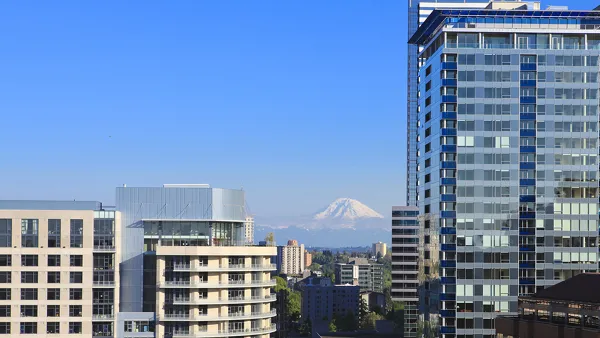
2020 Population Growth Rates for the 50 Biggest U.S. Cities
The Census Bureau released new data on May 27 that includes the first four months of the pandemic. Seattle tops the growth rate at 2.2% from July 1, 2019, to July 1, 2020, while Baltimore and San Francisco land at the bottom with -1.4%.

Air taxis to connect Texas airports to business hubs
Archer Aviation says its taxis will turn 90 minute drives into 20 minute flights.
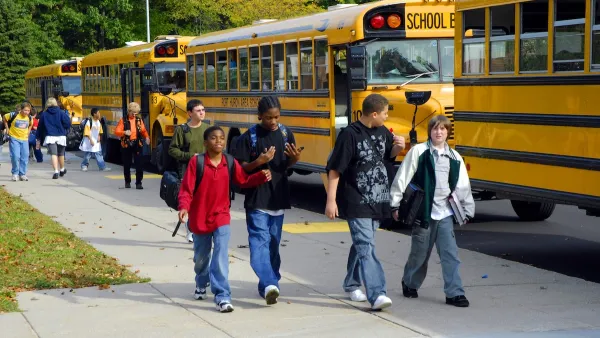
Learning loss and urban schools, part 2
Did test scores in progressive cities drop more post-COVID than test scores in moderate ones?

Planetizen Federal Action Tracker
A weekly monitor of how Trump’s orders and actions are impacting planners and planning in America.

California plans to bury El Niño’s downpour
If the state plays its cards right, it may be able to store a billion acre-feet of El Niño’s water in aquifers.

Desperate measures: Advocates weigh draining Lake Powell to fill Colorado River
Draining the reservoir could reduce evaporation losses by a couple hundred thousand acre-feet.

Los Angeles just elected an urban planner as its mayor
Transportation analysts are optimistic that Raman will be more aggressive in addressing transit issues than Bass.

Mamdani’s pied-à-terre tax survives legal challenge
A panel of judges found that the plaintiffs failed to demonstrate injury as a result of New York City's implementation of the tax.

Eastern Nebraska is running out of electricity
Data centers and electrification are straining eastern Nebraska’s grid, throttling economic development.

FREE Course: Walkable City 1: Why Walkability?
After describing his path towards focusing on walkability as the essence of good planning, Jeff Speck marches through his five principal reasons for making more walkable places.
Reinventing Malls: Planning Alchemy—Turning Gray Fields Into Gold
The course focuses on the opportunities and imperatives that shape reinvention of mall sites.

City of Rosemead
Rutgers University, Edward J. Bloustein School of Planning and Public Policy
One Hundred Miles
University of Michigan School for Environment and Sustainability (SEAS)
Hunter College, City University of New York (CUNY)
The Architects Foundation
City of Cambridge
Montrose County
The Pocatello Development Authority