A recent protest movement to reuse London’s Parliament Square as a space for political discourse has been met with oppressive policing.


As reported in the Guardian by David Graeber, the Occupy Democracy movement attempting to "turn Parliament Square back to the purposes to which it was, by most accounts, originally created: a place for public meetings and discussions, with an eye to bringing all the issues ignored by politicians in Westminster back into public debate," began last Tuesday and since then has been under attack.
According to British law, permanent tent cities are illegal. Organizers were aiming to maintain a 24-hour presence, but police have been finding nearly every excuse to storm into a demonstration, lecture, or workshop at any given time and confine the protestors into smaller spaces further and further.
Graeber discusses the role of policing public space and activism by writing, "When people get together, brilliant ideas invariably emerge. But it’s impossible to bring people together unless there is a location, a place where they can always go, 24/7, to meet people and begin to have conversations and make plans. This is precisely what our political authorities have decided that Londoners must never again be allowed to have."
Read the full story: Occupy Democracy is not considered newsworthy. It should be

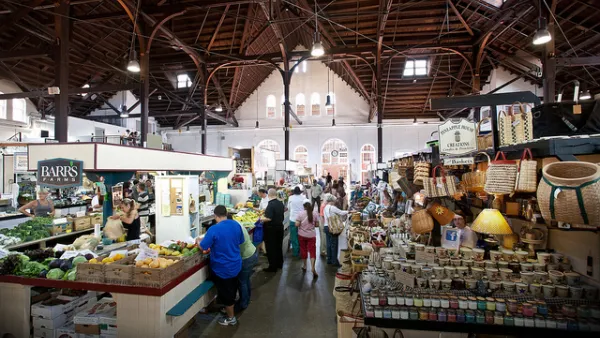
Imagining the Future Urban Food Market
Public food markets can be key centers of urban commerce and social life. Late last year, a brainstorming event in London considered how they might evolve to accommodate modern lifestyles and technologies.
One Year Later, Assessing Occupy Wall Street's Effect on Space
On the one-year anniversary of the beginning of Occupy Wall Street, Richard Sennett looks at the movement's legacy with regards to rethinking public space.
A Musical Experiment in Public Space
This piece looks at a public art project that placed 30 pianos in public places throughout London in an effort to encourage more public interaction.

Planetizen Federal Action Tracker
A weekly monitor of how Trump’s orders and actions are impacting planners and planning in America.

Amtrak, CN end decades-long dispute with eight-year agreement
The new operating agreement establishes an updated framework for the companies to work together, including processes to resolve disputes.

Judges permit Denver to divert 77,000 acre feet from the Colorado River for reservoir expansion
Overuse and climate change have caused the Colorado River’s water levels to plummet.

Boston has spent millions making the Green Line more accessible — and there’s no end in sight
While the city has invested millions into expanding and adding platforms to the Green Line to make it more accessible, new train cars set to arrive next year will be too tall for disabled passengers to board without raising the current platforms.

Idaho may see an 18% drop in federal surface transit funding — the largest estimated cut in the US
Transit systems in rural communities are much more reliant on federal funding to provide their services.

How ‘post-disaster gentrification’ alters neighborhoods after natural calamities
After hurricanes, fires or other calamities, the original residents of a community are often replaced by younger, wealthier residents.

FREE Course: Walkable City 1: Why Walkability?
After describing his path towards focusing on walkability as the essence of good planning, Jeff Speck marches through his five principal reasons for making more walkable places.
Reinventing Malls: Planning Alchemy—Turning Gray Fields Into Gold
The course focuses on the opportunities and imperatives that shape reinvention of mall sites.

City of Wisconsin Rapids
Harvard University Graduate School of Design
KFH Group Inc.
The Architects Foundation
University of Cincinnati Online
The Pocatello Development Authority
The Urban Renewal Agency of the City of Pocatello