"A new report out of Rutgers University reveals that since 2010, the fringes of the New York region have lost population as the core has grown," according to an article by Stephen Miller.


Stephen Miller shares news of a study, "The Receding Metropolitan Perimeter," [pdf] out of Rutgers University. After comparing regional growth between 1950 and 1980 to the most recent available data, which covers 2010 to 2013, study authors (James W. Hughes and Joseph J. Seneca of the Edward J. Bloustein School of Planning and Public Policy) "say recent shifts may signal the beginning of a long-term change toward more compact growth, while acknowledging that it’s too early to conclusively say so."
Trends since 2000 have nearly reversed the three-decades of growth between 1950 and 1980: "Suburban counties kept growing, but at barely a fifth of the annual rate seen in earlier decades. The highest growth rates were in inner ring locations like Bergen, Westchester, and Fairfield counties. In contrast, there were actual population losses in nearly half of the suburban counties, almost entirely on the fringe of the region, including Putnam, Dutchess, Sullivan, and Ulster counties in New York, and Sussex, Warren, and Hunterdon counties in New Jersey."
Read the full story: Peak Sprawl? The Fringes of the New York Region Are Shrinking

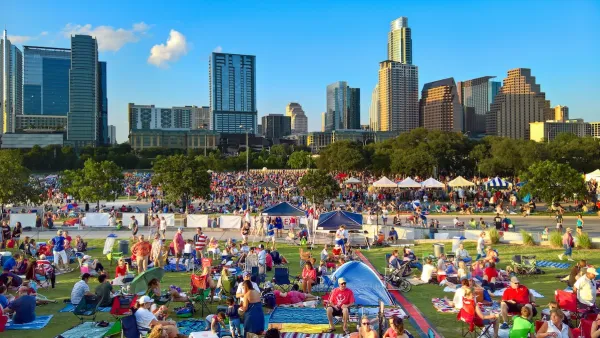
Texas Could Have the Nation’s 3 Largest Cities by 2100. Are They Ready to Embrace Density?
Houston, Dallas, and Austin are growing fast. The old sprawl model is no longer sustainable.
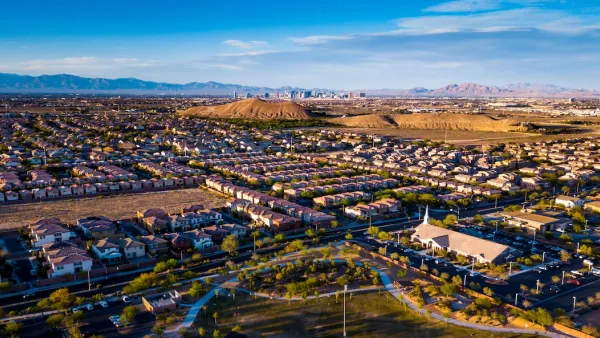
The Nation’s 40 Fastest-Growing Suburbs
Projected population growth will be concentrated in suburban communities around major metropolitan areas, with the Sunbelt experiencing the fastest growth.
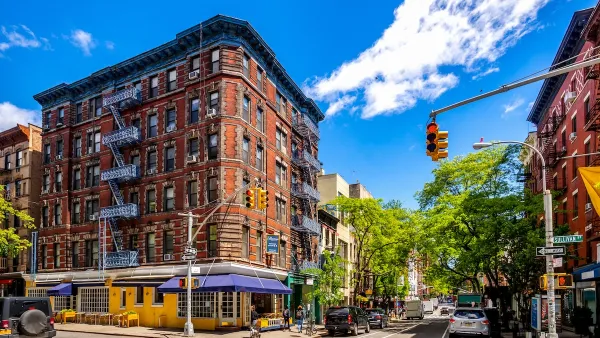
In Dense NYC, What Does ‘Human Scale’ Mean?
Advocates reject the NIMBY label, arguing that they seek a more sustainable, incremental pace of growth modeled on mid-rise neighborhoods.

Planetizen Federal Action Tracker
A weekly monitor of how Trump’s orders and actions are impacting planners and planning in America.

Amtrak, CN end decades-long dispute with eight-year agreement
The new operating agreement establishes an updated framework for the companies to work together, including processes to resolve disputes.

Judges permit Denver to divert 77,000 acre feet from the Colorado River for reservoir expansion
Overuse and climate change have caused the Colorado River’s water levels to plummet.

How ‘post-disaster gentrification’ alters neighborhoods after natural calamities
After hurricanes, fires or other calamities, the original residents of a community are often replaced by younger, wealthier residents.

Maryland local governments examine if they should have more power to raise property taxes
Maryland’s housing market is out of reach for the majority of moderate-income residents.

Northwest rail fans eager for Sept. 30 debut of Amtrak’s Airo fleet
Get ready for that new train smell and more seats. But they won’t go faster or run more frequently on the Cascades route in Washington and Oregon.

FREE Course: Walkable City 1: Why Walkability?
After describing his path towards focusing on walkability as the essence of good planning, Jeff Speck marches through his five principal reasons for making more walkable places.
Reinventing Malls: Planning Alchemy—Turning Gray Fields Into Gold
The course focuses on the opportunities and imperatives that shape reinvention of mall sites.

Harvard University Graduate School of Design
KFH Group Inc.
Greater Baltimore Committee
The Architects Foundation
University of Cincinnati Online
The Pocatello Development Authority
The Urban Renewal Agency of the City of Pocatello