Advocates reject the NIMBY label, arguing that they seek a more sustainable, incremental pace of growth modeled on mid-rise neighborhoods.


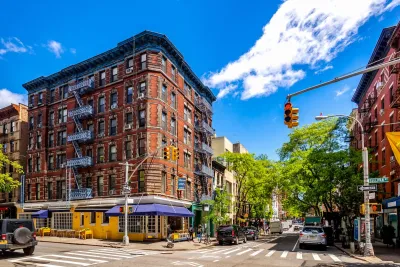
In an op-ed in Next City, Lynn Ellsworth, author of Wonder City: How to Reclaim Human-Scale Urban Life, argues that the New Yorkers who fight high-rise developments are not the “narrow-minded, greedy homeowners obsessively trying to raise and protect their property values” they are sometimes made out to be, but rather everyday residents who “want their city to support the thriving of ordinary residents” through “human-scaled, incremental build-out.”
Ellsworth draws on her own experience as a New Yorker involved in preservation battles. Ellsworth and her fellow human-scale advocates “favor incremental projects on small sites rather than massive rebuilding on huge sites. They want to stop the endless displacement of anyone who is not rich. They want an end to the misguided “luxury city” policy that New York’s politicians formally adopted when Michael Bloomberg became mayor in 2002.”
These advocates want to see an end to the privatization of parks, sidewalks, schools, and other public spaces. “They understand that thriving depends on the presence of a great public realm of schools and parks and swimming pools and a great subway system. Their vision includes places that support children, small businesses, plants, and animals. It is the very opposite of the towerized hyper-dense proposals of the real estate industry.”
FULL STORY: Reclaiming a Human-Scaled Vision of New York City


The Trouble With QUIMBY
The idea of “quality urbanism in my back yard” has its uses, but should not be used to limit housing supply.

Commentary: A New ‘Grand Bargain’ for American Housing
For decades, many U,S, neighborhoods successfully resisted change at the expense of a few neighborhoods sacrificed to mass development. Is there a better way?

How Cities Are Resisting State Efforts To Increase Density
Cities are attempting to wrest back local control over land use and zoning via some ingenious—and sometimes disingenuous—strategies.

The state-sanctioned urbicide of Austin
People don’t kill cities. Freeways do.

US to reduce Colorado River water deliveries to Mexico
A new Colorado Treaty amendment reduces Mexico’s Colorado River water allocation by 250,000 acre feet.

New Jersey’s second-largest city bans standalone data centers
Jersey City will continue to allow co-location facilities, such as those meant for research institutions that store their own data.

Amtrak not solely to blame for New Jersey commuter rail's unreliability, report finds
A new study from the Garden State Initiative found that NJ Transit’s budget grew 20% across a 4 year period, but reliability declined significantly over the same period.

EPA erases limits on planet-warming pollution from power plants
Under Monday’s plan, power plants would still have some limits on how much mercury, arsenic and other contaminants they can emit.

Phoenix announces new on-demand transit service, more frequent RAPID buses
Both new services will launch in October, and are part of Phoenix's Project Effective Access Solutions for Easing Congestion.

FREE Course: Walkable City 1: Why Walkability?
After describing his path towards focusing on walkability as the essence of good planning, Jeff Speck marches through his five principal reasons for making more walkable places.
Reinventing Malls: Planning Alchemy—Turning Gray Fields Into Gold
The course focuses on the opportunities and imperatives that shape reinvention of mall sites.

Eagle County Government
Harvard University Graduate School of Design
Nashville Planning Department
The Architects Foundation
University of Cincinnati Online
The Pocatello Development Authority
The Urban Renewal Agency of the City of Pocatello
Journal of the American Planning Association