Funded by a grant from the California Department of Transportation, Long Beach released an RFP for conceptual and design services for a plan to transform the Terminal Island Freeway into a "regional serving greenbelt and local serving road."


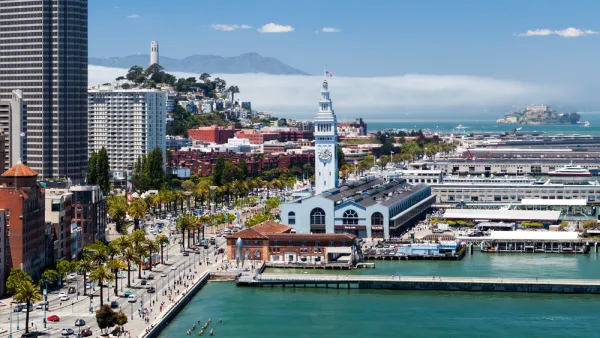
Brian Addison shares the big news: "the project to remove a large portion of the Terminal Island (TI) Freeway in West Long Beach has officially gone out to bid in an RFP with an estimated bid value of $225K." On the significance of the project, Addison adds this: " It marks a major event in Southern California’s urban design history, being the first freeway removal project that mirrors existing projects such as the removal of both of San Francisco’s Embarcadero Freeway and Central Freeway."
The TI Freeway Transition Plan [RFP], as it's called, will include a community engagement process to determine a vision for replacing the freeway with green space and pollution mitigation measures.
Read the full story: RFP Goes Out for Terminal Island Freeway Removal Project; Marks SoCal’s First Freeway Removal Project
When Removing a Freeway Becomes Mundane
As a growing number of communities study freeway removal, what if the decision was no longer controversial? In Long Beach, California, two city-owned freeways carry less traffic than some neighborhood streets. Would anyone notice if they were gone?
Urban Revitalization Through Highway Teardowns
Alana Semuels, staff writer for The Atlantic, examines highway teardowns beginning with the San Francisco Embarcadero in 1989 to see how they have worked in terms of revitalizing poorer areas or restoring the urban fabric that they destroyed.

The food desert that fed me
I expected to struggle to find food in West Long Beach. Instead, a network of community gardens, home bakers and kind neighbors made the trip one of the best-fed weeks of my life.

Desperate measures: Advocates weigh draining Lake Powell to fill Colorado River
Draining the reservoir could reduce evaporation losses by a couple hundred thousand acre-feet.

Eastern Nebraska is running out of electricity
Data centers and electrification are straining eastern Nebraska’s grid, throttling economic development.

Move over, LA: St. Louis gears up for Olympics, invests millions in downtown redevelopment
The Missouri city will host the 2028 Olympic soccer group stage and knockout matches.

Mass. votes against statewide minimum lot size for single-family homes
Over 2 million residents voted on Question 7; it was decided by just over 30,000 votes.

Maryland’s $15 billion bridge project gains key approval
The Maryland Transit Authority said the project will create over 60,000 jobs and add $23 billion to the local economy.

‘No clear next steps’ for Chicago's permanent festival grounds
Eleventh Ward Ald. Nicole Lee has suggested Soldier Field as a possible location for the permanent event space.

FREE Course: Walkable City 1: Why Walkability?
After describing his path towards focusing on walkability as the essence of good planning, Jeff Speck marches through his five principal reasons for making more walkable places.
Reinventing Malls: Planning Alchemy—Turning Gray Fields Into Gold
The course focuses on the opportunities and imperatives that shape reinvention of mall sites.


City of Rosemead
Rutgers University, Edward J. Bloustein School of Planning and Public Policy
One Hundred Miles
University of Michigan School for Environment and Sustainability (SEAS)
Hunter College, City University of New York (CUNY)
The Architects Foundation
City of Cambridge
Montrose County
The Pocatello Development Authority