As a growing number of communities study freeway removal, what if the decision was no longer controversial? In Long Beach, California, two city-owned freeways carry less traffic than some neighborhood streets. Would anyone notice if they were gone?


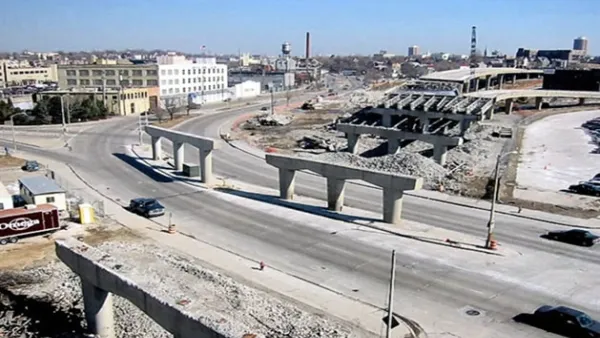
Brian Ulaszewski discusses a handful of recent examples of freeway teardowns that were replaced with little effect, like the Park East Freeway in Milwaukee:
"The original plan called for this freeway to reach the downtown waterfront, but community backlash against the destruction of neighborhoods prevented the plan from being completely realized. In 2003, city officials eventually decided to remove the mile of the freeway that had been built (and was carrying 54,000 vehicles daily). What motivated this decision was the realization that demolishing the aging freeway would cost $25 million, but rebuilding it would have cost four times as much. Concerns over congestion were misplaced: the reestablished street grid largely absorbed the traffic, while additionally creating nearly 40 acres of land for private development."
Ulaszewski is proposing the removal of a couple of lengths of freeway in Long Beach, California.
Thanks to Brian Ulaszewski
Read the full story: To Remove a Freeway in Long Beach (Part 2): By the Numbers
Bridging Divides: The Crucial Role of Collaboration in Highway Removal
Highway removal is most successful when agencies at all levels of government work closely with each other and the impacted community.

Southern California First: Freeway Teardown Project Coming to Long Beach
Funded by a grant from the California Department of Transportation, Long Beach released an RFP for conceptual and design services for a plan to transform the Terminal Island Freeway into a "regional serving greenbelt and local serving road."
Celebrating Highway Removal Success Stories
In advance of Next American City’s upcoming "Reimagining Urban Highways" conference in Philadelphia, Matt Bevilacqua reports on a new study examining the successful replacement of urban highways with boulevards and parks.

Planetizen Federal Action Tracker
A weekly monitor of how Trump’s orders and actions are impacting planners and planning in America.

Eastern Nebraska is running out of electricity
Data centers and electrification are straining eastern Nebraska’s grid, throttling economic development.

Study reveals best places in the U.S. for cycling, walking
New research from Streetlight Data examines bicycle and pedestrian miles per capita in the 100 largest U.S. cities by population.

Federal government nominates new FTA administrator
Mark Aesch is currently the founder and CEO of a transportation management consulting firm.

Developers reveal $10 billion stadium plan as ‘Hail Mary’ to keep Bears in Chicago
The plan would also boast a public park, high- and mid-rise buildings and a youth sports complex.

As Texas embraces carbon storage, a Black community questions the risks
Texas now issues permits for companies to store carbon dioxide underground. East Texas residents fear safety risks, and skeptics doubt the climate benefits.

FREE Course: Walkable City 1: Why Walkability?
After describing his path towards focusing on walkability as the essence of good planning, Jeff Speck marches through his five principal reasons for making more walkable places.
Reinventing Malls: Planning Alchemy—Turning Gray Fields Into Gold
The course focuses on the opportunities and imperatives that shape reinvention of mall sites.

City of Charlotte
City of Rosemead
Rutgers University, Edward J. Bloustein School of Planning and Public Policy
University of Michigan School for Environment and Sustainability (SEAS)
Hunter College, City University of New York (CUNY)
The Architects Foundation
City of Cambridge
The Pocatello Development Authority
The Urban Renewal Agency of the City of Pocatello