A planned shutdown of the nation's largest commuter railroad on Sunday morning appears to have been averted after MTA leaders reached a tentative labor agreement was reached with the eight labor unions after Gov. Andrew Cuomo joined the talks.


"The coalition of eight unions, which represent about 5,400 workers, have been in protracted negotiations for some time. Threats of a strike had intensified in recent days, after a breakdown of negotiations on Monday. Both sides blamed the other for the possibility of the strike, which would have begun early Sunday morning," writes Ryan Hutchins, transit reporter for Capital New York.
Cuomo's involvement, which began only on Wednesday after a four-hour bargaining session yielded no results, appears to have played the decisive role, according to Pete Donohue and John Lauinger of the New York Daily News.
Negotiations that were kick-started at Cuomo’s direction on Wednesday and went well into the night before resuming Thursday morning finally yielded an agreement in the early afternoon — ending a labor dispute that had been building since 2010.
"Under the terms of the agreement, which must be ratified by union membership and approved by the Metropolitan Transportation Authority's (MTA) board, current (Long Island Rail Road) LIRR employees will receive 17-percent raises over the contract’s 6 1/2-year term," adds Hutchins.
Jessica Gould, politics and public finance reporter for WNYC, writes that a significant part of the labor contract is one particular concession made by labor, "paying a portion of their health care for the first time."
"The deal will not lead to increases in rider fares—set to climb at the rate of inflation—and will not affect the ability of the M.T.A. to make needed repairs and upgrades, chairman Tom Prendergast said," Hutchins notes.
The governor's successful intervention, after initially distancing himself from the talks, may play well in his re-election bid this November, suggests WNYC's Karen Rouse.
The outcome was different from 1994, when Cuomo's father, former Gov. Mario Cuomo was in office. The railroad workers did strike, though not for long. But the consequences were memorable. He lost reelection [sic] to a fourth term.
According to its webpage in the MTA website, "(t)he Long Island Rail Road is the busiest commuter railroad in North America, carrying an average of 301,000 customers each weekday on 735 daily trains...(It) is comprised of over 700 miles of track on 11 different branches, stretching from Montauk -- on the eastern tip of Long Island -- to the refurbished Penn Station in the heart of Manhattan, approximately 120 miles away."
[Correspondent note: Hat tip to Adam Snider of Politico Morning Transportation]
Read the full story: With Cuomo, M.T.A. and LIRR unions announce deal
New York Subway Fares Jump to $2.75 Today
The $2.50 subway fare is set to rise by a quarter, but will service improve? This New York Times article focuses on problems plaguing the 110-year-old New York subway (second oldest after Boston's), but fares are increasing for all MTA services.
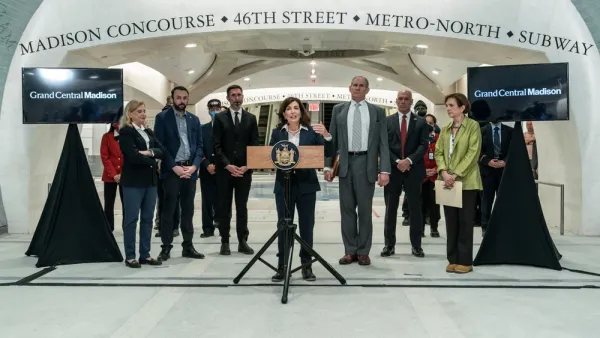
Long Island Rail Now Connects to Grand Central Terminal
A new rail service launched this week could save commuters as much as 40 minutes on trips between Long Island and Manhattan.
New York MTA Seeks Federal Funding Relief as Ridership Plummets
The Metropolitan Transportation Authority has seen significant ridership drops due to the coronavirus. The agency is asking Congress for $4 billion to help it through the crisis.

Planetizen Federal Action Tracker
A weekly monitor of how Trump’s orders and actions are impacting planners and planning in America.

California plans to bury El Niño’s downpour
If the state plays its cards right, it may be able to store a billion acre-feet of El Niño’s water in aquifers.

Desperate measures: Advocates weigh draining Lake Powell to fill Colorado River
Draining the reservoir could reduce evaporation losses by a couple hundred thousand acre-feet.

Los Angeles just elected an urban planner as its mayor
Transportation analysts are optimistic that Raman will be more aggressive in addressing transit issues than Bass.

Mamdani’s pied-à-terre tax survives legal challenge
A panel of judges found that the plaintiffs failed to demonstrate injury as a result of New York City's implementation of the tax.

Eastern Nebraska is running out of electricity
Data centers and electrification are straining eastern Nebraska’s grid, throttling economic development.

FREE Course: Walkable City 1: Why Walkability?
After describing his path towards focusing on walkability as the essence of good planning, Jeff Speck marches through his five principal reasons for making more walkable places.
Reinventing Malls: Planning Alchemy—Turning Gray Fields Into Gold
The course focuses on the opportunities and imperatives that shape reinvention of mall sites.

City of Rosemead
Rutgers University, Edward J. Bloustein School of Planning and Public Policy
One Hundred Miles
University of Michigan School for Environment and Sustainability (SEAS)
Hunter College, City University of New York (CUNY)
The Architects Foundation
City of Cambridge
Montrose County
The Pocatello Development Authority