A San Francisco city attorney spokesman used some colorful language in response to MonkeyParking's recent act of defiance against the city.


As we noted earlier, "a 'cease-and-desist letter' was sent June 23 to MonkeyParking, a Rome-based tech startup that developed and markets an app that allows motorists to auction public parking spaces beginning at $5."
City Attorney Dennis Herrera contends MonkeyParking and two other similar parking startups [ParkModo and Sweetch] also facing legal action have built business models entirely premised on illegal transactions - selling access to part of a public street, wrote John Coté earlier.
Coté updates the story, crediting MonkeyParking with "chutzpah." "In a newly released statement, MonkeyParking CEO Paolo Dobrowolny, derided Herrera’s cease and desist letter as 'an open violation of free speech'.”
“I have the right to tell people if I am about to leave a parking spot, and they have the right to pay me for such information,” Dobrowolny said, adding that "the city was improperly trying to apply a 'pre-shared economy' law to a 'shared economy' service.”
That defense didn't sit well with "Herrera spokesman Matt Dorsey (who) described that justification as “wildly inventive verbal gymnastics.”
Let’s be honest. It’s like a prostitute saying she’s not selling sex — she’s only selling information about her willingness to have sex with you,” Dorsey said. “It’s semantic hair splitting — and it’s absurd.”
Salon's Andrew Leonard was more direct: "This, pretty much everyone would agree, is an example of how the “sharing economy” can be totally bullshit."
In some cases, the parking app companies have done more than just sell information, as Coté indicated in his earlier piece.
One of the (three parking app) companies, ParkModo, is even hiring people at $13 an hour to occupy parking spaces in the trendy Mission District during the peak evening hours this week and then sell the spots as a way of promoting the company's smartphone app.
Herrera warned MonkeyParking that unless he shuts down the app by July 11, "(m)otorists would face $300 fines for each violation and MonkeyParking could be liable for penalties of up to $2,500 per transaction," writes Jessica Kwong of the San Francisco Examiner.
Read the full story: MonkeyParking tells SF it’s not going to kill its parking app
MonkeyParking App Is Back—This Time It's Legal
The infamous MonkeyParking app that last year ran afoul of public sentiment and the law is back with a new business model that offers residents the chance to auction that most precious of commodities—urban parking space.
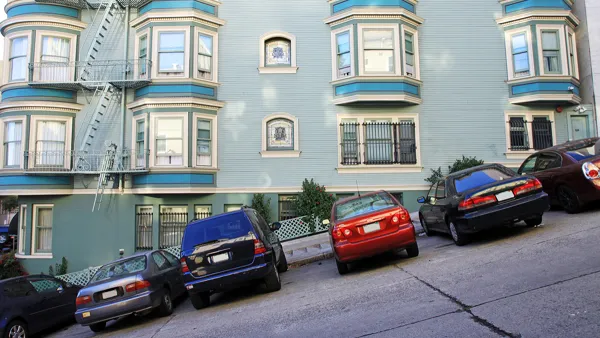
Monkey Parking is Monkey Business, Warns San Francisco City Attorney
A "cease-and-desist letter" was sent June 23 to MonkeyParking, a Rome-based tech startup that developed and markets an app that allows motorists to auction public parking spaces beginning at $5. The city attorney demanded shut-down by July 11.
New App Would Auction Public Parking Spaces
The MonkeyParking app works similarly to sharing economy stars Airbnb or Uber, except for sale is an inside line on parking spaces. That means that private users would be auctioning the use of public space. That can't be legal, can it?

Planetizen Federal Action Tracker
A weekly monitor of how Trump’s orders and actions are impacting planners and planning in America.

California plans to bury El Niño’s downpour
If the state plays its cards right, it may be able to store a billion acre-feet of El Niño’s water in aquifers.

Desperate measures: Advocates weigh draining Lake Powell to fill Colorado River
Draining the reservoir could reduce evaporation losses by a couple hundred thousand acre-feet.

Los Angeles just elected an urban planner as its mayor
Transportation analysts are optimistic that Raman will be more aggressive in addressing transit issues than Bass.

Mamdani’s pied-à-terre tax survives legal challenge
A panel of judges found that the plaintiffs failed to demonstrate injury as a result of New York City's implementation of the tax.

Eastern Nebraska is running out of electricity
Data centers and electrification are straining eastern Nebraska’s grid, throttling economic development.

FREE Course: Walkable City 1: Why Walkability?
After describing his path towards focusing on walkability as the essence of good planning, Jeff Speck marches through his five principal reasons for making more walkable places.
Reinventing Malls: Planning Alchemy—Turning Gray Fields Into Gold
The course focuses on the opportunities and imperatives that shape reinvention of mall sites.

City of Rosemead
Rutgers University, Edward J. Bloustein School of Planning and Public Policy
One Hundred Miles
University of Michigan School for Environment and Sustainability (SEAS)
Hunter College, City University of New York (CUNY)
The Architects Foundation
City of Cambridge
Montrose County
The Pocatello Development Authority