Urbanization may turn conventional thinking about vaccinations on its head, at least in India.


Worried parents ignoring scientific advice isn't the only thing reducing child access to immunization. The Times of India reports decreasing immunization among a negative relationship between immunization coverage levels and proximity to towns. "As the proportion of villages in the district which were located at a distance of more than 10 km from the nearest town increased, the probability of decline in immunization coverage decreased,” the report authors present.
While expecting declines in rural districts, as most cities and national health programs have worked to decrease exposure to diseases from low-cost vaccinations. Lower vaccination protection occurs, Rema Nagarajan reports, mostly in "peri-urban areas... inhabited by migratory urban poor and characterized by vulnerability due to concentration of population and social diversity, which co-exists with rural traits of isolation and invisibility to policy makers."
The Indian subcontinent is not the only region to experience higher levels of communicable disease and lower immunization in urban areas in the past several years.
This poses a challenge to planning for services as the growth of cities continues, particularly in poorer peri-urban environments, or ones that fall outside of a municipality or unincorporated area with rising communicable disease threat.
Read the full story: How urbanization is driving decline in immunization levels

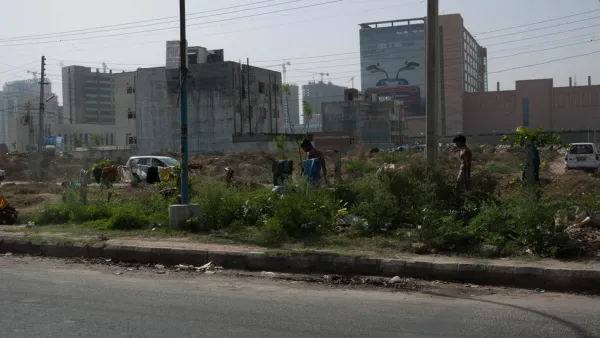
Friday Eye Candy: India's Rapid Urbanization
Photographer and architect Lars Mortensen captured the new face of urbanization in Gurgaon, a suburb of New Delhi. The scales involved are unprecedented, and rich and poor live in close proximity.
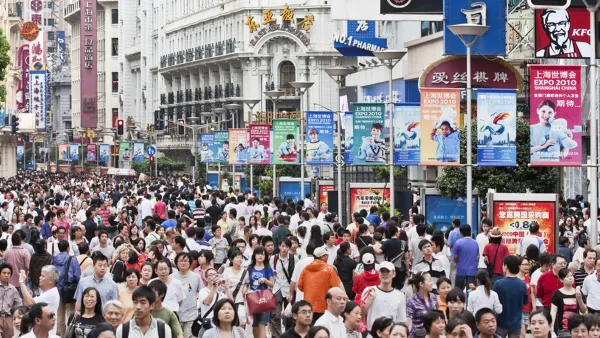
Visualizing Global Urban Growth Through 2030
Geographer Duncan Smith mapped the predicted trajectory of worldwide urban growth from 1950 through 2030. Concentric circles of different shades show where and when growth was (or will be) the most dramatic.
India's 'Census Towns' Struggle to Keep Up with Growth
As rural areas urbanize, India's land classification system leaves many without power to implement services.

Planetizen Federal Action Tracker
A weekly monitor of how Trump’s orders and actions are impacting planners and planning in America.

Amtrak, CN end decades-long dispute with eight-year agreement
The new operating agreement establishes an updated framework for the companies to work together, including processes to resolve disputes.

Judges permit Denver to divert 77,000 acre feet from the Colorado River for reservoir expansion
Overuse and climate change have caused the Colorado River’s water levels to plummet.

NYC DOT wants faster, more permanent street upgrades
The city is examining ways to build more concrete infrastructure without getting entangled in 'decades-long' projects.

'Something we’ve never seen before:' rising utility rates could strain city finances nationwide
Data centers, climate change and other factors have caused utility rates in the United States to increase by 38% since 2020.

Trump to overrule local leaders, lease millions of acres of America’s Pacific Island territories’ seafloors to mining companies
International law says that the Indigenous people of America’s territories have a right to prior and informed consent regarding projects that impact their countries.

FREE Course: Walkable City 1: Why Walkability?
After describing his path towards focusing on walkability as the essence of good planning, Jeff Speck marches through his five principal reasons for making more walkable places.
Reinventing Malls: Planning Alchemy—Turning Gray Fields Into Gold
The course focuses on the opportunities and imperatives that shape reinvention of mall sites.

Harvard University Graduate School of Design
KFH Group Inc.
Greater Baltimore Committee
The Architects Foundation
University of Cincinnati Online
The Pocatello Development Authority
The Urban Renewal Agency of the City of Pocatello