Los Angeles County has allocated an additional $10.2 million to expand the Family Solutions Centers program, which supports some of the estimated 7,391 homeless families living in the county.


According to the website of Los Angeles County Supervisor Mark Ridley-Thomas, “[the] Family Solutions Centers started last March with $3.7 million in city and county funding, with the goal of rapidly rehousing homeless households and offering centers throughout Los Angeles County where homeless can go to have problems professionally assessed.”
The centers are a result of a regional approach to homelessness launched in 2010. Now, “there are seven lead agencies that host Family Solution Centers in six of the eight service planning areas in Los Angeles County.”
The program consulted 1,542 families between March and December. “Three hundred and two of those families were able to avoid homelessness, 305 were placed in interim housing, and 417 were provided permanent housing.”
Read the full story: Can Housing L.A. County's Homeless Families Save Money?
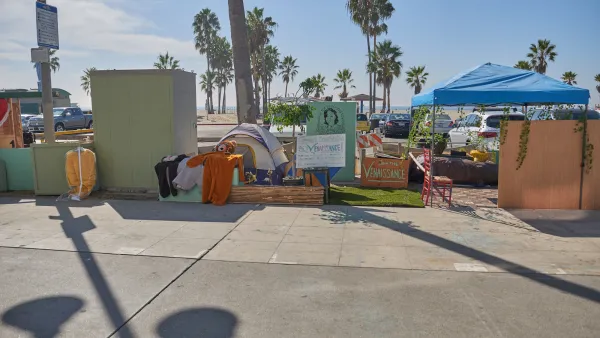
LA Proposal Would Forcibly Remove Unhoused People Near Olympic Venues
Los Angeles County sent city officials a report outlining strategies for clearing homeless encampments, but advocates point out that the report itself notes there are not enough shelte resources to accommodate all unhoused residents.
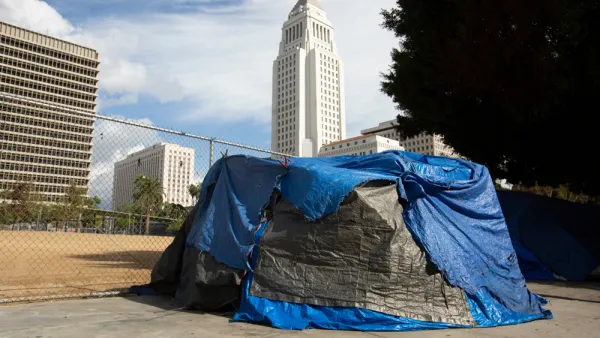
L.A. County Towns Clash Over Homelessness Policies
Local governments often come to different conclusions about how to address homelessness within their respective borders, but varying approaches only exacerbate the problem.
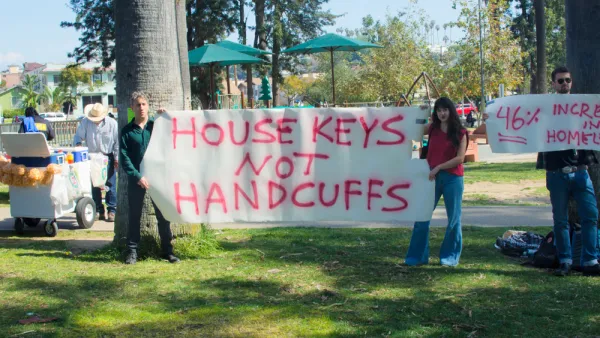
The Complexity of Homelessness in Los Angeles County
The homeless crisis is complicated and is associated with high housing costs, inadequate shelter spaces, deinstitutionalization, changes in the criminal justice system, and other factors.

Planetizen Federal Action Tracker
A weekly monitor of how Trump’s orders and actions are impacting planners and planning in America.

Eastern Nebraska is running out of electricity
Data centers and electrification are straining eastern Nebraska’s grid, throttling economic development.

Study reveals best places in the U.S. for cycling, walking
New research from Streetlight Data examines bicycle and pedestrian miles per capita in the 100 largest U.S. cities by population.

DSA members accuse Mamdani of 'abandoning values' over housing redevelopment
New York City's mayor plans to replace about 2,000 units of public housing with private, mixed-income housing.

All sides of BRT debate unhappy with CDOT’s most recent move
The Colorado Department of Transportation is no longer considering center-running bus lanes for Colorado Boulevard.

Massachusetts bogs generate both power, and cranberries
Putting solar panels above farmland is one way Massachusetts is advancing toward its goal of net-zero carbon emissions by 2050.

FREE Course: Walkable City 1: Why Walkability?
After describing his path towards focusing on walkability as the essence of good planning, Jeff Speck marches through his five principal reasons for making more walkable places.
Reinventing Malls: Planning Alchemy—Turning Gray Fields Into Gold
The course focuses on the opportunities and imperatives that shape reinvention of mall sites.

City of Rosemead
Rutgers University, Edward J. Bloustein School of Planning and Public Policy
One Hundred Miles
University of Michigan School for Environment and Sustainability (SEAS)
Hunter College, City University of New York (CUNY)
The Architects Foundation
City of Cambridge
The Pocatello Development Authority
The Urban Renewal Agency of the City of Pocatello