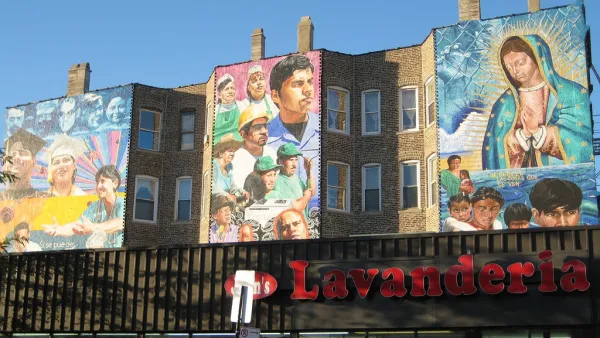
Around the country, highly educated, upwardly mobile Latinos are choosing urban settings in traditionally Latino neighborhoods over the suburbs. The effects of "gente-fication" ("gente" is Spanish for "people") are distinct from gentrification.


Soni Sangha provides personal stories, and some data, behind the trend of "gente-fication" found in neighborhoods like Lincoln Heights in Los Angeles. "A growing number of upwardly mobile Latinos would rather take the good and bad of Lincoln Heights than idyllic suburbs, in a trend that some refer to as 'gente-fication,'" writes Sangha.
Although the movement is conspicuous in Los Angeles, the pattern is also clear in Houston, Phoenix, and New York City.
As with gentrification, gente-fication raises concerns about brain drain, diplacement, affordability, and, yes, hipsters (chipsters in this case), but "the trend echoes a growing desire among Latinos, in particular, to live in walkable communities that can support many generations under one roof." Aangha quotes Rudy Espinoza, who lives in the Boyle Heights neighborhood of Los Angeles to explain the commitment to Latino culture that motivates gente-fication: "We’ve gone to college and we’ve come back with these new tools we’ve acquired. Let’s apply them to our communities and bring them to bear.”
Read the full story: In Taking Back Urban Areas, Latinos Are Causing A 'Gente-fication' Across The U.S.
Can Gentrification Integrate Neighborhoods?
Hector Tobar argues that despite the well-documented ills of gentrification, under the right circumstances it can eat into long decades of racial segregation. Eastern Los Angeles may be a prime test case.

Passengers in New York, California lift off in air taxis
Two air taxi companies have received a Special Airworthiness Market Survey Certificate, which allows them to service passengers.
How LA’s new mayor plans to tackle affordable housing crisis
Mayor-elect Nithya Raman has proposed overhauling the city’s permitting process.

Washington state to charge fee to drivers with fuel-efficient cars
Revenue from the fee will go towards supporting the state’s highways.

Illinois considers spending $1 billion in taxpayer money on data center
A quantum computing campus and data center are currently under construction in Chicago.

Trump to blast ‘hydrocarbon highway’ through ‘world’s longest art gallery’
Environmental and historic preservation groups are suing to stop the project.

NYC, state sue feds over mixed-immigration-status housing assistance rule
The state’s lawsuit argues that the rule change violates the Administrative Procedure Act.

Michigan to turn neighborhood into virtual power plant
Residents will soon be able to divert their excess energy to the grid in exchange for compensation.

Data center, mining project swarm to long-awaited Alaska railroad line
The state-owned railroad approved final plans for the spur line this week; the project is expected to cost $311 million, mostly funded by the federal government

FREE Course: Walkable City 1: Why Walkability?
After describing his path towards focusing on walkability as the essence of good planning, Jeff Speck marches through his five principal reasons for making more walkable places.
Reinventing Malls: Planning Alchemy—Turning Gray Fields Into Gold
The course focuses on the opportunities and imperatives that shape reinvention of mall sites.

City of Charlotte
City of Rosemead
Rutgers University, Edward J. Bloustein School of Planning and Public Policy
University of Michigan School for Environment and Sustainability (SEAS)
Hunter College, City University of New York (CUNY)
The Architects Foundation
University District Partnership