Planners in the city of San Francisco have a proposed a $1.4 million study to examine the possibility of removing part of Interstate 280 in the city and convert a rail yard would yield 37 acres of prime urban real estate.



A new $1.4 million study would examine the benefits, and financial realities of removing part of a freeway and converting an existing rail yard into a “high quality urban environment,” if approved by the city and county of San Francisco.
“[The study] will look for the best way to transform the three-block-long rail yard into a new urban neighborhood before building the downtown rail extension that will bring Caltrain to the new Transbay Transit Center, the planned electrification of Caltrain and the opening of still-uncertain high-speed rail system, which would also go to the transit center,” reports John Wildermuth.
The proposed study follows “[a] preliminary and much-less-detailed study in 2012 of the area suggested that land freed up by moving the rail yard and converting the freeway into a surface-level boulevard at 16th Street near Mariposa Street.” The conclusion of that idea: “[the land] could be sold to developers for up to $228 million, an estimate the study described as conservative.”
Read the full story: Study to look at demolishing I-280, moving train yard
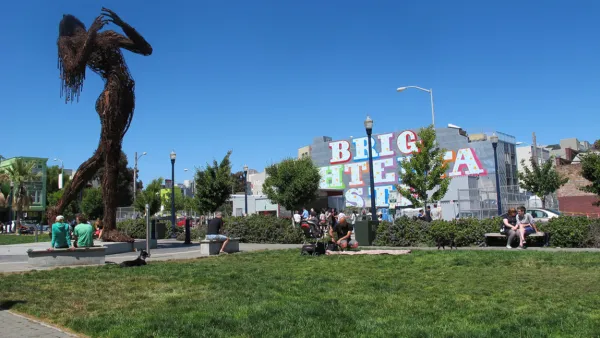
San Francisco: Model for Freeway Removal
Architecture critic John King tagged along with the Congress for New Urbanism. The latter was recently in San Francisco to examine the benefits of freeway removal. The city's prime case study: Octavia Boulevard.
San Francisco Debates Tearing Down More Freeways
One of the cities that's led the growing trend in urban freeway removal is considering another tear down, report Phillip Matier and Andrew Ross.
When Removing a Freeway Becomes Mundane
As a growing number of communities study freeway removal, what if the decision was no longer controversial? In Long Beach, California, two city-owned freeways carry less traffic than some neighborhood streets. Would anyone notice if they were gone?

Planetizen Federal Action Tracker
A weekly monitor of how Trump’s orders and actions are impacting planners and planning in America.

Washington state to charge fee to drivers with fuel-efficient cars
Revenue from the fee will go towards supporting the state’s highways.

Illinois considers spending $1 billion in taxpayer money on data center
A quantum computing campus and data center are currently under construction in Chicago.

People Mover delayed again, LAX and contractor trade barbs
The automated train was last slated to open in January 2027.

Trump to blast ‘hydrocarbon highway’ through ‘world’s longest art gallery’
Environmental and historic preservation groups are suing to stop the project.

25 states cast bids to be the home of U.S. Space Academy
The academy will train scientists, officers and astronauts for the U.S. Space Force.

FREE Course: Walkable City 1: Why Walkability?
After describing his path towards focusing on walkability as the essence of good planning, Jeff Speck marches through his five principal reasons for making more walkable places.
Reinventing Malls: Planning Alchemy—Turning Gray Fields Into Gold
The course focuses on the opportunities and imperatives that shape reinvention of mall sites.

City of Charlotte
City of Rosemead
Rutgers University, Edward J. Bloustein School of Planning and Public Policy
University of Michigan School for Environment and Sustainability (SEAS)
Hunter College, City University of New York (CUNY)
The Architects Foundation
University District Partnership