One of the cities that's led the growing trend in urban freeway removal is considering another tear down, report Phillip Matier and Andrew Ross.


After the successful removal of the Embarcadero and Central freeways, and their replacement with attractive street-level boulevards, "Mayor Ed Lee is floating the idea of tearing down the stub end of Interstate 280 in San Francisco in hopes of creating a new neighborhood and speeding up the arrival of high-speed rail service downtown," report Matier and Ross.
"The idea, laid out by the mayor's chief transit planner, Gillian Gillett, in a memo to the regional Metropolitan Transportation Commission, would be to knock down I-280 before 16th Street - eliminating the ramps both at Sixth and Brannan streets and at Fourth and King streets."
"The plan also calls for clearing out the adjacent rail yard to make way for a high-speed rail line," they add. However, "some transit insiders worry that a potential fight over a freeway pull-down could actually slow the high-speed rail planning process."
Read the full story: Ed Lee talks of tearing down end of I-280
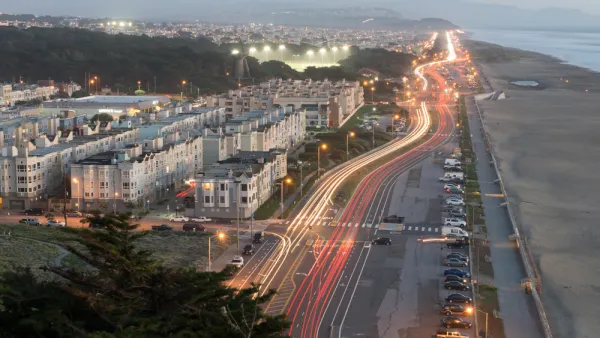
San Francisco Planning to Remove the Great Highway as Coastal Erosion Takes its Toll
In the 1920s, the city of San Francisco extended the shoreline of south Ocean Beach by some 200 feet. Now the coast there is eroding as a result of that action, and the Great Highway is on shaky ground.
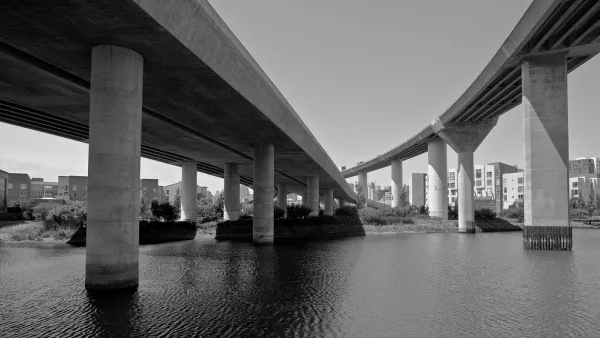
San Francisco Planners Pitch Freeway Removal
Planners in the city of San Francisco have a proposed a $1.4 million study to examine the possibility of removing part of Interstate 280 in the city and convert a rail yard would yield 37 acres of prime urban real estate.
'Mr. Mayor, Tear Down This Freeway', Says San Francisco Planning Think Tank
In their June magazine, SPUR proposes a bold vision for transforming several San Francisco neighborhoods based on three big moves: tear down the end of Interstate 280, put Caltrain and high-speed rail underground, and redevelop the Caltrain railyard.

Planetizen Federal Action Tracker
A weekly monitor of how Trump’s orders and actions are impacting planners and planning in America.

California plans to bury El Niño’s downpour
If the state plays its cards right, it may be able to store a billion acre-feet of El Niño’s water in aquifers.

Desperate measures: Advocates weigh draining Lake Powell to fill Colorado River
Draining the reservoir could reduce evaporation losses by a couple hundred thousand acre-feet.

Los Angeles just elected an urban planner as its mayor
Transportation analysts are optimistic that Raman will be more aggressive in addressing transit issues than Bass.

Mamdani’s pied-à-terre tax survives legal challenge
A panel of judges found that the plaintiffs failed to demonstrate injury as a result of New York City's implementation of the tax.

Eastern Nebraska is running out of electricity
Data centers and electrification are straining eastern Nebraska’s grid, throttling economic development.

FREE Course: Walkable City 1: Why Walkability?
After describing his path towards focusing on walkability as the essence of good planning, Jeff Speck marches through his five principal reasons for making more walkable places.
Reinventing Malls: Planning Alchemy—Turning Gray Fields Into Gold
The course focuses on the opportunities and imperatives that shape reinvention of mall sites.

City of Rosemead
Rutgers University, Edward J. Bloustein School of Planning and Public Policy
One Hundred Miles
University of Michigan School for Environment and Sustainability (SEAS)
Hunter College, City University of New York (CUNY)
The Architects Foundation
City of Cambridge
Montrose County
The Pocatello Development Authority