In their June magazine, SPUR proposes a bold vision for transforming several San Francisco neighborhoods based on three big moves: tear down the end of Interstate 280, put Caltrain and high-speed rail underground, and redevelop the Caltrain railyard.



In a persuasive article, illustrated with compelling graphics, SPUR's Boulevard Task Force lays out the impetus for, and advantages of, the three moves described above in order to inspire city leaders to study the proposals.
"Taken together, these moves improve the entire area, knitting together SOMA, Mission Bay and Potrero Hill. They also have the potential to generate financial value by developing newly available land and making existing land more valuable," argue the authors. "This value can in turn be recaptured by the public sector to fund transit and urban design improvements. Taking such steps could be transformative for the area and for the city as a whole."
"We believe that this approach could be a regional and national model for how to use thoughtful development to retrofit past planning mistakes and pay for new infrastructure."
Read the full story: Taking Down a Freeway to Reconnect a Neighborhood


Caltrain Railyard Redevelopment Back on the Table in San Francisco
An incredibly complex development proposal for 20 acres of Caltrain railyard is back on the table, nearly a decade since it first made news in San Francisco.
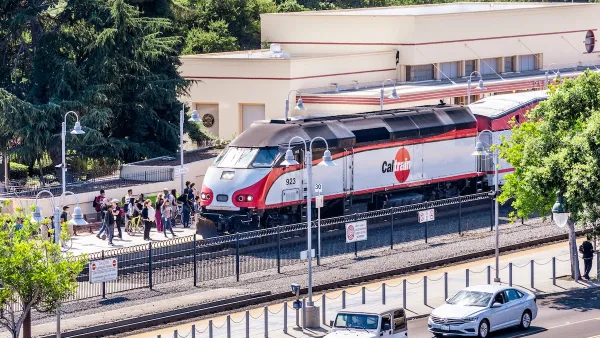
Caltrain may slash over one-third of its stations
If Bay Area voters reject two transit tax measures, Caltrain, BART and AC Transit will see steep service cuts.
Op-Ed: To Survive, Bay Area Transit Needs Integration
Advocates for ‘seamless’ transit are calling on California state leaders to tie a consolidation study to a one-time injection of funding into the Bay Area’s transit systems.

Planetizen Federal Action Tracker
A weekly monitor of how Trump’s orders and actions are impacting planners and planning in America.

California plans to bury El Niño’s downpour
If the state plays its cards right, it may be able to store a billion acre-feet of El Niño’s water in aquifers.

Chicago breaks ground on $3 billion megadevelopment
The new neighborhood, titled Foundry Park, will one day host 3,700 residences.

California High-Speed Rail Authority CEO resigns after $600,000 scandal
Under Ian Choudri, the authority used taxpayer dollars to fund first class flights and trips to nightclubs.

Want to study the Missouri River? Soon, you may need unanimous approval from 10 states
Legislation would require 10 governors’ permission to study or build projects moving water outside the basin.

Desperate measures: Advocates weigh draining Lake Powell to fill Colorado River
Draining the reservoir could reduce evaporation losses by a couple hundred thousand acre-feet.

FREE Course: Walkable City 1: Why Walkability?
After describing his path towards focusing on walkability as the essence of good planning, Jeff Speck marches through his five principal reasons for making more walkable places.
Reinventing Malls: Planning Alchemy—Turning Gray Fields Into Gold
The course focuses on the opportunities and imperatives that shape reinvention of mall sites.

City of Rosemead
Rutgers University, Edward J. Bloustein School of Planning and Public Policy
One Hundred Miles
Hunter College, City University of New York (CUNY)
The Architects Foundation
University of Cincinnati Online
City of Cambridge
Montrose County
The Pocatello Development Authority