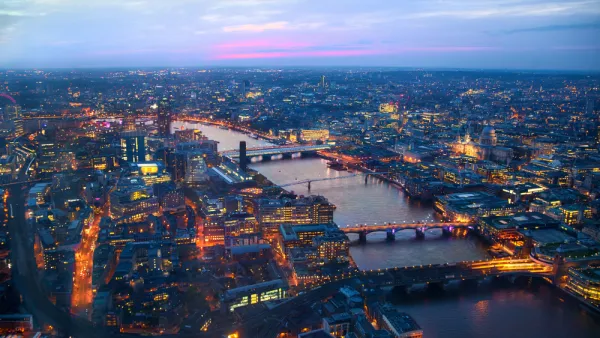
A new study out of Oxford’s Saïd Business School provides evidence of the influence of external factors, such as foreign wars and environmental crises, on the London housing market.


Jason Karaian, covering the new report for Quartz, first describes the well established outlier that is London’s housing market relative to the rest of the country: “For some time, property prices in London have disconnected from the UK as a whole; London homes are both the most expensive and fastest appreciating in the country. The average London house is now worth £441,000 ($724,000), versus the £248,000 national average.”
Karaian quotes the researchers directly to announce the report’s findings: “Our empirical results document that increases in political uncertainty in Southern Europe, China, Russia, and the Middle East are associated with well-identified increases in London house prices in specific wards.”
Providing a further layer of interpretation, buyers from different parts of the world will buy in different parts of town as a response to turmoil: “Turmoil in China, Russia, and the Middle East is strongly correlated with price rises in well-to-do London neighborhoods, while upheaval in Southern Europe and South Asia is more closely linked with price hikes in lower-income wards with a large share of residents from those regions.”
Read the full story: Riots in Egypt + recession in Greece = property boom in London
Around the Globe, Urban Diversity Is Alive and Well
It might feel like the world is shrinking as globalization expands, but many cities still have their individual characters and qualities.
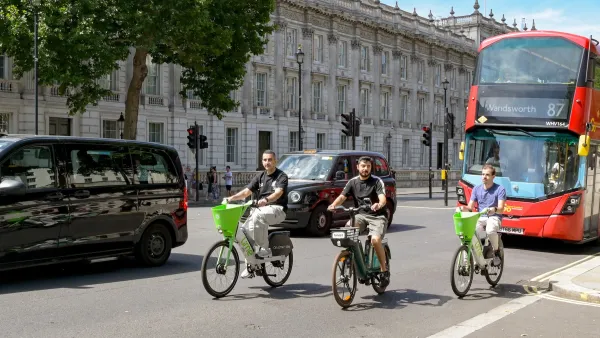
Bike use in London grew by 43% since 2019, but car use remains roughly the same
The city's efforts to reduce car use have stalled despite ambitious programs like congestion pricing and low-traffic neighborhoods.

Beavers save London Tube station from flooding
A small group of beavers is increasing biodiversity and creating cost-free flood mitigation infrastructure.

Washington state to charge fee to drivers with fuel-efficient cars
Revenue from the fee will go towards supporting the state’s highways.

Illinois considers spending $1 billion in taxpayer money on data center
A quantum computing campus and data center are currently under construction in Chicago.

Trump to blast ‘hydrocarbon highway’ through ‘world’s longest art gallery’
Environmental and historic preservation groups are suing to stop the project.

NYC, state sue feds over mixed-immigration-status housing assistance rule
The state’s lawsuit argues that the rule change violates the Administrative Procedure Act.

Michigan to turn neighborhood into virtual power plant
Residents will soon be able to divert their excess energy to the grid in exchange for compensation.

Data center, mining project swarm to long-awaited Alaska railroad line
The state-owned railroad approved final plans for the spur line this week; the project is expected to cost $311 million, mostly funded by the federal government

FREE Course: Walkable City 1: Why Walkability?
After describing his path towards focusing on walkability as the essence of good planning, Jeff Speck marches through his five principal reasons for making more walkable places.
Reinventing Malls: Planning Alchemy—Turning Gray Fields Into Gold
The course focuses on the opportunities and imperatives that shape reinvention of mall sites.

City of Charlotte
City of Rosemead
Rutgers University, Edward J. Bloustein School of Planning and Public Policy
University of Michigan School for Environment and Sustainability (SEAS)
Hunter College, City University of New York (CUNY)
The Architects Foundation
University District Partnership