Christopher Hawthorne reports that Frank Gehry is back in charge of the design for the quixotic $650-million Grand Avenue redevelopment after a disastrous redesign nearly scuttled the star-crossed project.


"After soliciting plans from other architects in recent months, Related has put Gehry back in charge of the design team for a $650-million retail, hotel and residential complex on Grand Avenue in downtown Los Angeles," reports Hawthorne. "On Monday the New York-based developer will submit a new proposal by Gehry's firm to the committee overseeing the project."
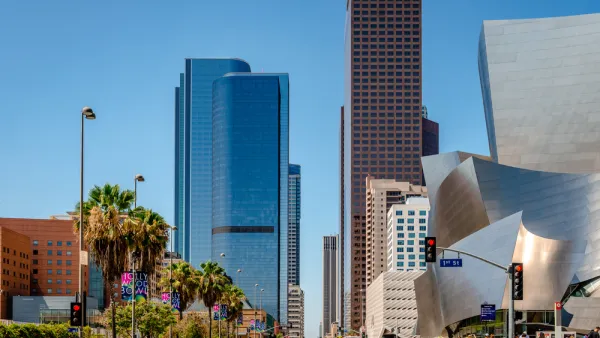
"Gehry's design is significantly more exuberant and suggestive of L.A. culture than designs for the site by the firms Gensler and Robert A.M. Stern Architects, which Los Angeles County Supervisor Gloria Molina, chair of the committee, blasted in September as bland and uninspired," he notes. "It calls for a stacked collection of shops and restaurants forming a U-shaped plaza directly across from Walt Disney Concert Hall."
While Hawthorne praises Gehry's vision of a set of "boxy towers" that "step up from a jumble of forms at ground level" for better relating to its neighbors, he observes that the architect "has work to do to unify this collection of stacked forms". And while the project is "better developed at street level than in any of the previous designs," he cautions that "[t]he last thing pedestrians on Grand or concertgoers coming out of Disney Hall want is a sense that the street design itself is funneling them straight into an open-air shopping mall."
Read the full story: Frank Gehry's Grand vision to go before project committee
Gehry's Latest Downtown L.A. Project Rises While Workers Stay Home
A high-profile project in the heart of the cultural and civic center of Downtown Los Angeles is rising quickly, and practically in secret, as the area's daytime population stays home during the pandemic.
Can Frank Gehry Avoid Repeating Downtown Los Angeles’ Mistakes?
The high profile Grand Avenue project in Los Angeles’ Downtown Civic Center had been stuck in recession purgatory for years, until updated design plans by Frank Gehry were announced. Can the new development avoid the failures of Grand Avenue’s past?
Poor Design Threatens L.A.'s Quixotic Grand Avenue Quest
With a key deadline looming today for downtown L.A.'s Grand Avenue project, a "little-noticed" decision last week by a public agency to reject the developer's most recent design has thrown the future of the elusive effort in doubt.

Planetizen Federal Action Tracker
A weekly monitor of how Trump’s orders and actions are impacting planners and planning in America.

California plans to bury El Niño’s downpour
If the state plays its cards right, it may be able to store a billion acre-feet of El Niño’s water in aquifers.

Desperate measures: Advocates weigh draining Lake Powell to fill Colorado River
Draining the reservoir could reduce evaporation losses by a couple hundred thousand acre-feet.

Los Angeles just elected an urban planner as its mayor
Transportation analysts are optimistic that Raman will be more aggressive in addressing transit issues than Bass.

Mamdani’s pied-à-terre tax survives legal challenge
A panel of judges found that the plaintiffs failed to demonstrate injury as a result of New York City's implementation of the tax.

Eastern Nebraska is running out of electricity
Data centers and electrification are straining eastern Nebraska’s grid, throttling economic development.

FREE Course: Walkable City 1: Why Walkability?
After describing his path towards focusing on walkability as the essence of good planning, Jeff Speck marches through his five principal reasons for making more walkable places.
Reinventing Malls: Planning Alchemy—Turning Gray Fields Into Gold
The course focuses on the opportunities and imperatives that shape reinvention of mall sites.

City of Rosemead
Rutgers University, Edward J. Bloustein School of Planning and Public Policy
One Hundred Miles
University of Michigan School for Environment and Sustainability (SEAS)
Hunter College, City University of New York (CUNY)
The Architects Foundation
City of Cambridge
Montrose County
The Pocatello Development Authority