At the edge of the Kubuqi Desert in Inner Mongolia a nonprofit organization is planting millions of trees to slow the advancing sands. At stake is the air quality in Beijing and, perhaps, "the viability of the Asian continent."


"Creeping deserts are a global problem. About one-third of the Earth is exposed to desertification, according to a 2004 United Nations study," writes Abigail Trafford.
"What makes desertification so problematic in Asia is the movement of sand toward population hubs." Sandstorms from the Kubuqi darken the skies over beijing, 800 miles away, and send plumes all the way to the West Coast of the U.S.
A nonprofit called Future Forest, was founded by former South Korean ambassador to China Byong Hyon Kwon in 2001 to address global desertification. Since 2006, they've been building a half-mile thick barrier of trees in the Kubuqi to stop the desert's eastward march. "The goal is to plant 100 million trees and thicken the green wall into habitable green space," notes Trafford.
“We would like to stop the desertification here,” the ambassador says. “I’m convinced we can do it.”
Read the full story: Let a billion trees bloom: Can a great green wall of trees stop China’s spreading desert?

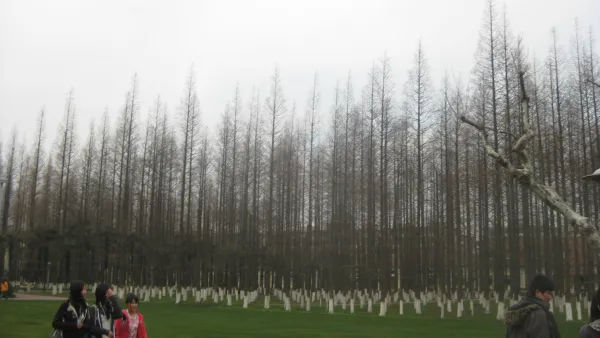
China Plants 'Great Green Wall' of Trees
Net deforestation continues, but at a slower rate as the world's largest ecological engineering project stretches for a planned 2,800 miles. It is hoped the new trees will halt the advance of the Gobi Desert.
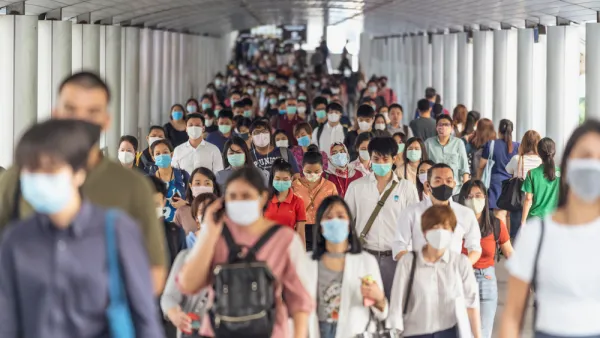
How Cities Are Responding to Automobile Congestion
As economies begin to reopen around the world, some cities are taking action to prevent widespread gridlock.

Coronavirus Effects on the Global Transportation System
As the coronavirus continues to move across the globe, its effects on shared transportation modes and freight shipping are becoming more apparent.

Planetizen Federal Action Tracker
A weekly monitor of how Trump’s orders and actions are impacting planners and planning in America.

Amtrak, CN end decades-long dispute with eight-year agreement
The new operating agreement establishes an updated framework for the companies to work together, including processes to resolve disputes.

Judges permit Denver to divert 77,000 acre feet from the Colorado River for reservoir expansion
Overuse and climate change have caused the Colorado River’s water levels to plummet.

NYC DOT wants faster, more permanent street upgrades
The city is examining ways to build more concrete infrastructure without getting entangled in 'decades-long' projects.

'Something we’ve never seen before:' rising utility rates could strain city finances nationwide
Data centers, climate change and other factors have caused utility rates in the United States to increase by 38% since 2020.

Trump to overrule local leaders, lease millions of acres of America’s Pacific Island territories’ seafloors to mining companies
International law says that the Indigenous people of America’s territories have a right to prior and informed consent regarding projects that impact their countries.

FREE Course: Walkable City 1: Why Walkability?
After describing his path towards focusing on walkability as the essence of good planning, Jeff Speck marches through his five principal reasons for making more walkable places.
Reinventing Malls: Planning Alchemy—Turning Gray Fields Into Gold
The course focuses on the opportunities and imperatives that shape reinvention of mall sites.

Harvard University Graduate School of Design
KFH Group Inc.
Greater Baltimore Committee
The Architects Foundation
University of Cincinnati Online
The Pocatello Development Authority
The Urban Renewal Agency of the City of Pocatello