Net deforestation continues, but at a slower rate as the world's largest ecological engineering project stretches for a planned 2,800 miles. It is hoped the new trees will halt the advance of the Gobi Desert.


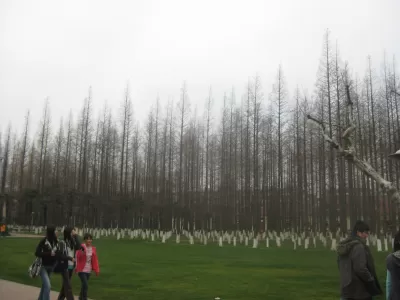
Beset by desertification and famously polluted, northern China has undertaken a massive reforestation project. Lily Kuo writes, "Reforestation efforts in China, combined with regrowth on abandoned farmland in Russia, have helped offset 81% of the loss in above-ground biomass carbon lost to tropical deforestation since 2003, according to a new study in the academic journal Nature Climate Change."
What has been dubbed the 'Great Green Wall' will be unprecedented in scope: "Overall, the country has planted 13 million hectares (32 million acres) of new forest since 2008, according to the State Forestry Administration." Officials hope the program will stall the Gobi Desert, which has been expanding toward Beijing.
Overall net tree cover is still dropping in China, but at a slower rate. Part of the problem is that the new trees are hardly part of a complex ecosystem: "many of the new trees are non-native fruit and rubber tree plantations that require large amounts of water, and are monocultures prone to disease and pests."
Read the full story: China is building a Great Wall of Trees to fight climate change and the encroaching Gobi Desert

Land Use the Subject of Latest IPCC Report
Not urban land use, but in the literal sense: land used to produce food, graze livestock, supply drinking water, grow trees, and sequester carbon. As the climate warms and the population grows, crop yields will decrease and land will be degraded.
Trump's proposed budget slashes EPA funding by 52%
The budget also reduces funding for FEMA, climate resilience projects, and water infrastructure programs.
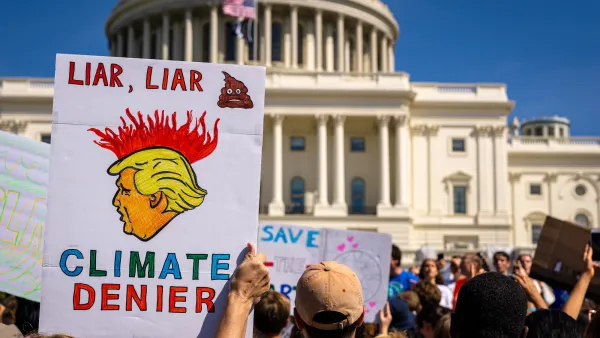
Dear Trump: the Future Belongs to the Efficient
Trump abandoned climate protection goals claiming that cheap fossil fuel helps consumers and the economy. A mobility-focused analysis shows that he is wrong: resource efficiency is the key to health, economic success and happiness.

Planetizen Federal Action Tracker
A weekly monitor of how Trump’s orders and actions are impacting planners and planning in America.

California plans to bury El Niño’s downpour
If the state plays its cards right, it may be able to store a billion acre-feet of El Niño’s water in aquifers.

Desperate measures: Advocates weigh draining Lake Powell to fill Colorado River
Draining the reservoir could reduce evaporation losses by a couple hundred thousand acre-feet.

Chicago voters approve permanent festival grounds, penalty for vacant property owners
Currently, major summer and fall festivals take over public parks for weeks at a time, drawing criticism from nearby residents

NYC votes to cut outdoor dining red tape, speed up permitting
New York City also voted to allow the Department of Transportation to begin work on urgent projects before notifying elected officials.

California appears to reject Prop. 45
The proposition would have expanded the projects that qualify for a streamlined environmental review, effectively paring down the California Environmental Quality Act.

FREE Course: Walkable City 1: Why Walkability?
After describing his path towards focusing on walkability as the essence of good planning, Jeff Speck marches through his five principal reasons for making more walkable places.
Reinventing Malls: Planning Alchemy—Turning Gray Fields Into Gold
The course focuses on the opportunities and imperatives that shape reinvention of mall sites.


City of Rosemead
Rutgers University, Edward J. Bloustein School of Planning and Public Policy
One Hundred Miles
Hunter College, City University of New York (CUNY)
The Architects Foundation
University of Cincinnati Online
City of Cambridge
Montrose County
The Pocatello Development Authority