Four years after the Great Recession technically ended, the rate at which Americans are choosing to relocate continues to decline and is now at historic lows. What is causing this long-term trend?


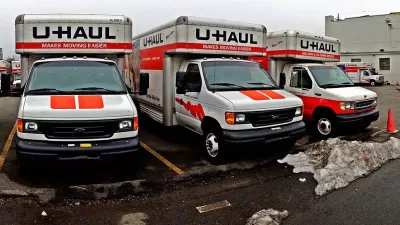
"Last year, about 36 million people in the U.S. picked up and moved, either across town or across the country. That was about one in 10 Americans, or 11.7 percent." Though that may seem like a lot of people, "this mobility rate, based on data released by the Census Bureau today, is about as low as it's ever been, dating all the way back to the 1940s," notes Emily Badger.
She suggests some probable reasons for the 60-year decline in American mobility and recent historic lows: the long-term rise of homeownership, the recession, and the aging of the country's population.
Read the full story: The Rise of Staying Put
U.S. Migration Reaches 72-Year Low
Staying in place is more and more the norm, even among historically mobile young people.
Congestion Costing Reality Check, Part 1: Congestion evaluation best practices
Widely cited studies claim that traffic congestion is a huge and growing problem. They exaggerate. Let’s examine how to correctly calculate congestion costs and roadway expansion benefits.
Rural Texas transit program is a 'lifeline' for seniors
A Central Texas program offers free transit to residents over 60.

Planetizen Federal Action Tracker
A weekly monitor of how Trump’s orders and actions are impacting planners and planning in America.

Eastern Nebraska is running out of electricity
Data centers and electrification are straining eastern Nebraska’s grid, throttling economic development.

Study reveals best places in the U.S. for cycling, walking
New research from Streetlight Data examines bicycle and pedestrian miles per capita in the 100 largest U.S. cities by population.

Next-generation nuclear reactors are coming to Texas
The reactors will not require towering containment structures thanks to new safety features.

California distributes $1.3 billion to prevent transit service cuts, bolster projects
Twenty-eight projects across California received a portion of the funding.

Pennsylvania Democrats have 15 affordability, clean energy bills for flipped state Senate
Bills in consideration include a bill supporting geothermal energy and a bill supporting solar on warehouses.

FREE Course: Walkable City 1: Why Walkability?
After describing his path towards focusing on walkability as the essence of good planning, Jeff Speck marches through his five principal reasons for making more walkable places.
Reinventing Malls: Planning Alchemy—Turning Gray Fields Into Gold
The course focuses on the opportunities and imperatives that shape reinvention of mall sites.


City of Charlotte
City of Rosemead
Rutgers University, Edward J. Bloustein School of Planning and Public Policy
University of Michigan School for Environment and Sustainability (SEAS)
Hunter College, City University of New York (CUNY)
The Architects Foundation
City of Cambridge
The Pocatello Development Authority
The Urban Renewal Agency of the City of Pocatello