Sure, having a boorish crack-smoking mayor who refuses to get help or step down is a problem. But Toronto's existential problems are structural, writes Richard Florida. The city's "outmoded growth model and system of governance" threaten its success.



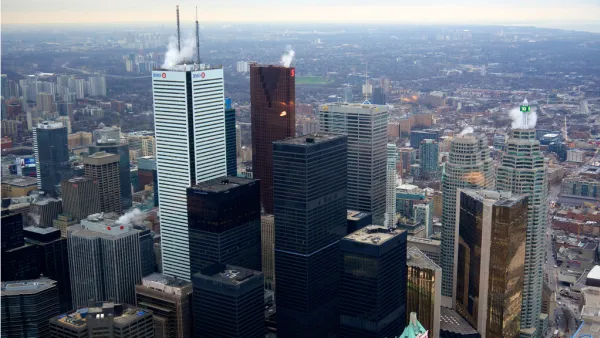
Toronto has an economy as big as Sweden’s, plentiful high-paying jobs in key sectors, and a rapidly growing population. "But Toronto has reached a true inflection point," says Florida, "and the problem is not high taxes or fiscal profligacy, as many have framed it. ... Toronto’s biggest problem is its growth model, which has far outlived its shelf life."
"When a city region like Toronto – or Atlanta, Washington, Dallas or Miami – hits the 5.5 to six million mark in population, it can no longer grow based on cars and sprawl," he explains. "It has to grow upward as well as outward and has to become much more oriented to transit."
But the city's challenges aren't limited to land use and mobility. "Toronto does not just need a new and better mayor to save it. It needs a new governance system that is adequate to the new challenges it faces," Florida argues. "Part of that is clear recall provisions that allow for the ouster of a dysfunctional mayor. But it needs to go far beyond that."
Read the full story: Toronto’s problem has grown beyond its mayor

Debating the End of Single-Family Zoning in Toronto
A retired city planner takes a position against "lot splitting," or allowing more than one unit on properties zones for single-family residential as it's known in Toronto.

For Lack of Density: Ontario Rejects Toronto's Downtown Plan
Local control loses ground to provincial preemption north of the border.
Growth Plan Debate Heats Up in Toronto
The question of how and where to grow is causing controversy in Toronto. A recent op-ed picks a side.

Planetizen Federal Action Tracker
A weekly monitor of how Trump’s orders and actions are impacting planners and planning in America.

Washington state to charge fee to drivers with fuel-efficient cars
Revenue from the fee will go towards supporting the state’s highways.

Illinois considers spending $1 billion in taxpayer money on data center
A quantum computing campus and data center are currently under construction in Chicago.

Senate passes bill overhauling permitting
The bill still needs to pass the House.

Did data centers change how voters cast their ballots?
Texas, Ohio, and Georgia all flipped party control. But in rural counties, the effect of local data centers was mixed.

Amtrak invests in eight new Airo trainsets
The new trainsets will begin serving passengers in 2031.

FREE Course: Walkable City 1: Why Walkability?
After describing his path towards focusing on walkability as the essence of good planning, Jeff Speck marches through his five principal reasons for making more walkable places.
Reinventing Malls: Planning Alchemy—Turning Gray Fields Into Gold
The course focuses on the opportunities and imperatives that shape reinvention of mall sites.

City of Charlotte
City of Rosemead
Rutgers University, Edward J. Bloustein School of Planning and Public Policy
University of Michigan School for Environment and Sustainability (SEAS)
Hunter College, City University of New York (CUNY)
The Architects Foundation
University District Partnership