One of the first portions of the World Trade Center PATH station has opened beneath West Street in Manhattan. The 100-foot-long pedestrian passageway provides a taste of Santiago Calatrava's design and what a seemingly unlimited budget can buy you.


I guess its not surprising that the world's most expensive train station has birthed the world's most expensive hallway. "The station’s total cost — $4 billion, plus another few hundred million for temporary stations — was what most first-world cities would pay for an entire rail line," notes Stephen J. Smith. "And this single pedestrian underpass, which runs from an office complex across the West Side Highway (which, despite its reinvention as West Street, still feels a lot like a highway), looks to account for at least $100 million."
According to Smith, the "cavernous and blindingly white" passageway, which connects the future station to the World Financial Center, seems to have dodged multiple cost-cutting bullets.
"The aboveground elements weren’t so lucky," he adds. "It turns out that the record-setting sum of $4 billion didn’t even buy New York a complete Calatrava design. The light and airy bird-like structure with a retractable roof simulating flight was value-engineered down, its wings rendered immobile and its rib-like supports doubled, leading to a heavier-looking structure."
Read the full story: This $100 Million, Calatrava-Designed Tunnel Is the World’s Most Expensive Hallway

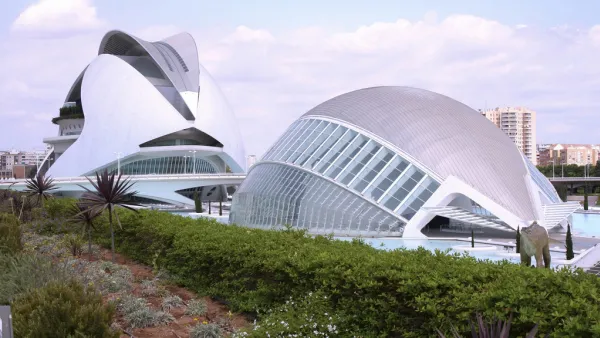
Will Anyone Hire Santiago Calatrava After this Exposé?
While many of Santiago Calatrava's anatomically-inspired designs are lauded, in Valencia - the architect's birthplace and the city where he's built the most - Calatrava is reviled for cost overruns, exorbitant fees, and inexplicable design errors.
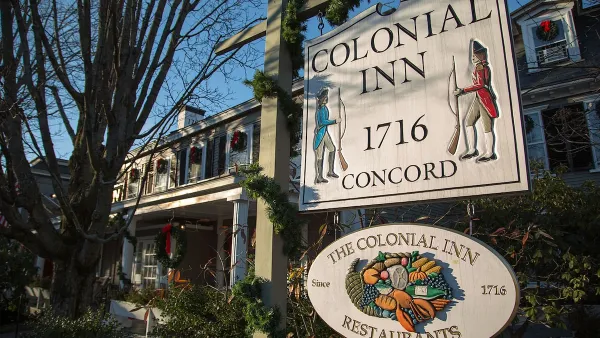
The Trust for Historic Preservation’s ‘Most Haunted’ Hotels of 2024
Looking for a historically creepy place to spend Halloween? Check out these haunted properties.

What Abandoned Places Teach Us
Abandoned cities and other forsaken human-built sites are haunted by the mistakes city leaders and builders have made over centuries.

Planetizen Federal Action Tracker
A weekly monitor of how Trump’s orders and actions are impacting planners and planning in America.

Amtrak, CN end decades-long dispute with eight-year agreement
The new operating agreement establishes an updated framework for the companies to work together, including processes to resolve disputes.

Judges permit Denver to divert 77,000 acre feet from the Colorado River for reservoir expansion
Overuse and climate change have caused the Colorado River’s water levels to plummet.

Boston has spent millions making the Green Line more accessible — and there’s no end in sight
While the city has invested millions into expanding and adding platforms to the Green Line to make it more accessible, new train cars set to arrive next year will be too tall for disabled passengers to board without raising the current platforms.

Idaho may see an 18% drop in federal surface transit funding — the largest estimated cut in the US
Transit systems in rural communities are much more reliant on federal funding to provide their services.

How ‘post-disaster gentrification’ alters neighborhoods after natural calamities
After hurricanes, fires or other calamities, the original residents of a community are often replaced by younger, wealthier residents.

FREE Course: Walkable City 1: Why Walkability?
After describing his path towards focusing on walkability as the essence of good planning, Jeff Speck marches through his five principal reasons for making more walkable places.
Reinventing Malls: Planning Alchemy—Turning Gray Fields Into Gold
The course focuses on the opportunities and imperatives that shape reinvention of mall sites.

City of Wisconsin Rapids
Harvard University Graduate School of Design
KFH Group Inc.
The Architects Foundation
University of Cincinnati Online
The Pocatello Development Authority
The Urban Renewal Agency of the City of Pocatello