While many of Santiago Calatrava's anatomically-inspired designs are lauded, in Valencia - the architect's birthplace and the city where he's built the most - Calatrava is reviled for cost overruns, exorbitant fees, and inexplicable design errors.


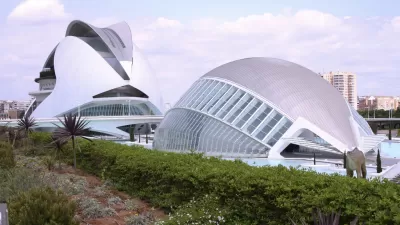
"Along with Frank Gehry, Richard Meier, Renzo Piano and Norman Foster, Mr. Calatrava swept to prominence in an era of showstopping architecture," writes Suzanne Daley. "Across the globe, he has designed dozens of structures, almost invariably white, including the Liège-Guillemins railway station in Belgium; the Turning Torso skyscraper in Malmo, Sweden; and the Milwaukee Art Museum, with its mechanical roof."
"But in numerous interviews, other architects, academics and builders say that Mr. Calatrava is amassing an unusually long list of projects marred by cost overruns, delays and litigation. It is hard to find a Calatrava project that has not been significantly over budget. And complaints abound that he is indifferent to the needs of his clients."
“What you see over and over again is that rather than searching for functionality or customer satisfaction, he aims for singularity,” said Jesús Cañada Merino, the president of Bilbao’s architects’ association. “The problem is that Calatrava is above and beyond the client.”
Read the full story: A Star Architect Leaves Some Clients Fuming
Opera Face-Off Contributes to Calatrava's Crumbling Legacy
In Valencia, workers will begin removing the sparkling mosaic facade that adorns the Queen Sofía Palace of the Arts today. The opera house's crumbling facade is the latest episode to tarnish architect Santiago Calatrava's professional reputation.
A Monstrous Price Tag for the World's Most Expensive Hallway
One of the first portions of the World Trade Center PATH station has opened beneath West Street in Manhattan. The 100-foot-long pedestrian passageway provides a taste of Santiago Calatrava's design and what a seemingly unlimited budget can buy you.
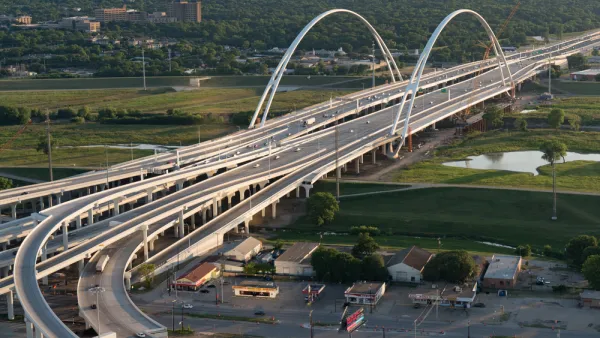
Dallas' Margaret McDermott Bridge Finally Open to Pedestrians and Cyclists
Overdue and over budget, infrastructure for pedestrian and people on bikes is finally available on the Margaret McDermott Bridge in Dallas.

Planetizen Federal Action Tracker
A weekly monitor of how Trump’s orders and actions are impacting planners and planning in America.

California plans to bury El Niño’s downpour
If the state plays its cards right, it may be able to store a billion acre-feet of El Niño’s water in aquifers.

Desperate measures: Advocates weigh draining Lake Powell to fill Colorado River
Draining the reservoir could reduce evaporation losses by a couple hundred thousand acre-feet.

Los Angeles just elected an urban planner as its mayor
Transportation analysts are optimistic that Raman will be more aggressive in addressing transit issues than Bass.

Mamdani’s pied-à-terre tax survives legal challenge
A panel of judges found that the plaintiffs failed to demonstrate injury as a result of New York City's implementation of the tax.

Eastern Nebraska is running out of electricity
Data centers and electrification are straining eastern Nebraska’s grid, throttling economic development.

FREE Course: Walkable City 1: Why Walkability?
After describing his path towards focusing on walkability as the essence of good planning, Jeff Speck marches through his five principal reasons for making more walkable places.
Reinventing Malls: Planning Alchemy—Turning Gray Fields Into Gold
The course focuses on the opportunities and imperatives that shape reinvention of mall sites.

City of Rosemead
Rutgers University, Edward J. Bloustein School of Planning and Public Policy
One Hundred Miles
University of Michigan School for Environment and Sustainability (SEAS)
Hunter College, City University of New York (CUNY)
The Architects Foundation
City of Cambridge
Montrose County
The Pocatello Development Authority