A new report sheds light on the costs of suburban sprawl that aren't well understood by officials and residents. If more knew the true financial costs they might reconsider their policies and priorities, believes author Dave Thompson.


"A little truth in advertising would go a long way in helping cities and taxpayers curb the sprawl that is robbing them of their time, health and clean air," argues Dave Thompson, author of a new report from Sustainable Prosperity, a University of Ottawa-based research network. "Planners and a growing number of politicians are now aware of the hidden costs of sprawl but the policies and the data they need to calculate the price of those developments hasn’t caught up, said Thompson."
"His report recommends policies that don’t leave cities picking up the cost of roads, community centres, police and fire services that have to be operated and maintained long after the development charges against builders have been spent," writes Tess Kalinowski.
“We’ve known about the environmental effects for decades, we’ve known about the health impacts for 10, 20 years,” said Thompson. “Now we’re learning that the financial costs of sprawl are going to be staggering and we’re leaving a major deficit to our children and grandchildren.”
Read the full story: Hidden costs of sprawl will cripple cities, report says
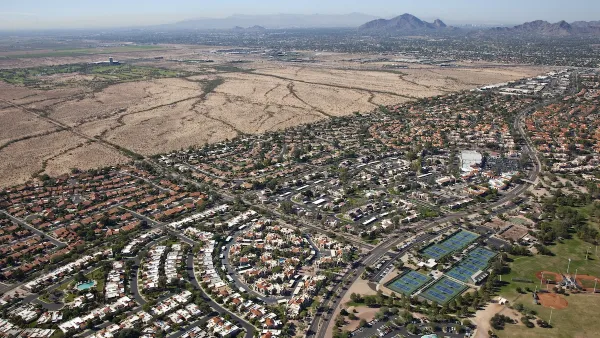
Nearly Half a Million New Arizona Homes Halted Due to Water Crisis
The Arizona Department of Water Resources has put a moratorium on new water supply permits, making the future of planned residential developments uncertain.
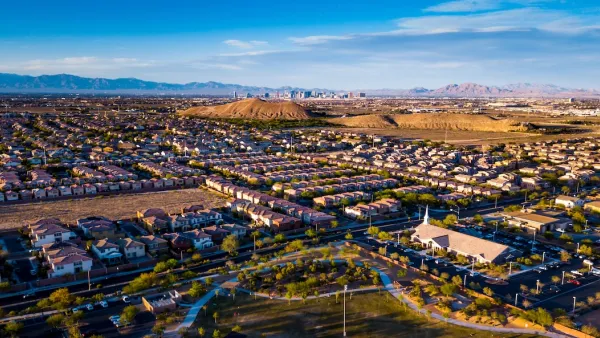
The Nation’s 40 Fastest-Growing Suburbs
Projected population growth will be concentrated in suburban communities around major metropolitan areas, with the Sunbelt experiencing the fastest growth.

The Natalist Case For Sprawl (And Why It Fails)
Some commentators defend anti-urban government policies such as exclusionary zoning on the basis that homeowning suburbanites have high birth rates. But this doesn't seem to be true in recent decades.

Planetizen Federal Action Tracker
A weekly monitor of how Trump’s orders and actions are impacting planners and planning in America.

California plans to bury El Niño’s downpour
If the state plays its cards right, it may be able to store a billion acre-feet of El Niño’s water in aquifers.

Desperate measures: Advocates weigh draining Lake Powell to fill Colorado River
Draining the reservoir could reduce evaporation losses by a couple hundred thousand acre-feet.

Los Angeles just elected an urban planner as its mayor
Transportation analysts are optimistic that Raman will be more aggressive in addressing transit issues than Bass.

Mamdani’s pied-à-terre tax survives legal challenge
A panel of judges found that the plaintiffs failed to demonstrate injury as a result of New York City's implementation of the tax.

Eastern Nebraska is running out of electricity
Data centers and electrification are straining eastern Nebraska’s grid, throttling economic development.

FREE Course: Walkable City 1: Why Walkability?
After describing his path towards focusing on walkability as the essence of good planning, Jeff Speck marches through his five principal reasons for making more walkable places.
Reinventing Malls: Planning Alchemy—Turning Gray Fields Into Gold
The course focuses on the opportunities and imperatives that shape reinvention of mall sites.

City of Rosemead
Rutgers University, Edward J. Bloustein School of Planning and Public Policy
One Hundred Miles
University of Michigan School for Environment and Sustainability (SEAS)
Hunter College, City University of New York (CUNY)
The Architects Foundation
City of Cambridge
Montrose County
The Pocatello Development Authority