London's wastewater problems go at least as far back as the 19th century, before a 1,100-mile system of tunnels was built to divert the city's waste downstream. A plan to fix that system with a tunnel financed by customer fees is raising a stink.


"Built for a city half London’s current size...the [Victorian era sewer] system is now overflowing," reports Julia Werdigier. "As often as once a week, raw sewage is forced into the Thames, a sharp change from the 19th century, when the newly built system overflowed less than once a year."
"The increasing flow of raw sewage — the result of the loss of green spaces to absorb rainwater as much as population gain — violates European environmental law, the European Commission said in 2009, and the government has promised to act."
"But in an era of austerity and strained budgets, it is not the government that is paying the $6.6 billion bill but Thames Water, a private company with shareholders," she adds. "There is a catch, of course: it is actually the customers of Thames Water who are paying for the project with higher water bills, a prospect almost as horrendous to today’s Londoners as the river’s stench was to their 19th-century forebears."
Read the full story: Plan Aims to Fix Sewers, but Its Cost to Residents Leaves a Bad Taste

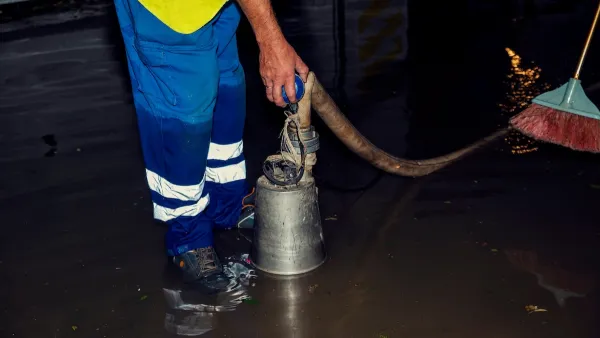
Baltimore Sewer Backup Assistance Programs Stall
Two programs aimed at helping residents safely clean up overflows caused by aging pipes are in limbo due to a dispute between the city and the EPA.
How Cities Are Using Wastewater to Test for COVID-19
Some scientists and city officials are moving ahead with a different way to track the virus’s spread: wastewater testing.

Lack of Septic Systems Spell Disaster for Low-Income Alabama Residents
Low-income Alabama residents who can't afford the cost of a functional septic tank run the risk of heavy fines and even arrest in addition to extremely unsafe conditions.

Planetizen Federal Action Tracker
A weekly monitor of how Trump’s orders and actions are impacting planners and planning in America.

Amtrak, CN end decades-long dispute with eight-year agreement
The new operating agreement establishes an updated framework for the companies to work together, including processes to resolve disputes.

Judges permit Denver to divert 77,000 acre feet from the Colorado River for reservoir expansion
Overuse and climate change have caused the Colorado River’s water levels to plummet.

Boston has spent millions making the Green Line more accessible — and there’s no end in sight
While the city has invested millions into expanding and adding platforms to the Green Line to make it more accessible, new train cars set to arrive next year will be too tall for disabled passengers to board without raising the current platforms.

Idaho may see an 18% drop in federal surface transit funding — the largest estimated cut in the US
Transit systems in rural communities are much more reliant on federal funding to provide their services.

How ‘post-disaster gentrification’ alters neighborhoods after natural calamities
After hurricanes, fires or other calamities, the original residents of a community are often replaced by younger, wealthier residents.

FREE Course: Walkable City 1: Why Walkability?
After describing his path towards focusing on walkability as the essence of good planning, Jeff Speck marches through his five principal reasons for making more walkable places.
Reinventing Malls: Planning Alchemy—Turning Gray Fields Into Gold
The course focuses on the opportunities and imperatives that shape reinvention of mall sites.

City of Wisconsin Rapids
Harvard University Graduate School of Design
KFH Group Inc.
The Architects Foundation
University of Cincinnati Online
The Pocatello Development Authority
The Urban Renewal Agency of the City of Pocatello