In a city known for its Beat history and hippie culture, the evolution of Fort Mason - a 237-year-old military post turned national park - into a haven for frat guys and "Google Girls" is an anomaly worthy of anthropological study.


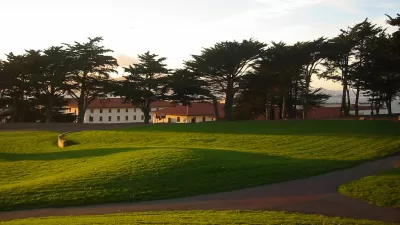
On a recent weekend afternoon, "[y]oung men in salmon-colored shorts lounged on a picnic blanket next to heavy red coolers" on the lawn of the Great Meadow in Fort Mason, observes Nellie Bowles. "A few strung hammocks between the lawn's palm trees. Others had set up corn-hole tables, horseshoe ranges, bocce ball and a volleyball court."
The scene is apparently so common in the military post turned national park that it's earned the area a new nickname: Frat Mason. " 'Cause it's like the fratty, preppy Dolores Park,' said 24-year-old Armando Anido Jr., an investment banker who dropped in from his South of Market pad. 'It's where you find the all the frat stars, especially on a Fraturday.' "
Though an official with the National Park Service may grumble about "trash mobs" and party hats being left on the statue of the park's founder, "[t]he new residents insist that partying is only a small part of what's going on at Fort Mason," notes Bowles. "They say that the neighborhood feels like family, where residents borrow sugar from each other and troubleshoot for their startups while, yes, sometimes having margaritas."
Read the full story: New S.F. neighborhood like a campus fraternity row
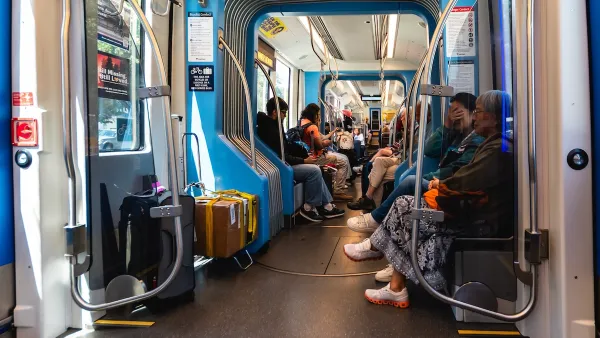
Voters choose public transit, approve $31 billion in funding
Approved projects include $101,000 for reduced-cost transit in a Michigan town and $14 billion for regional transit in the San Francisco Bay Area.
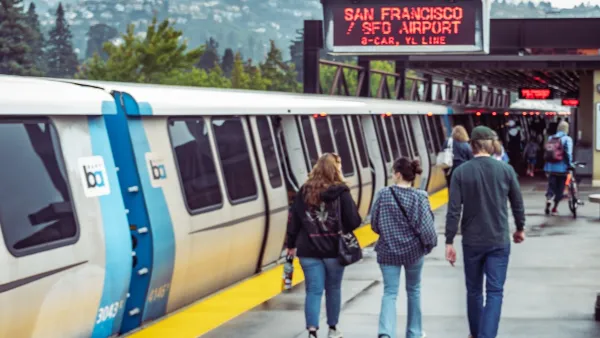
Bay area voters pass ‘crucial lifeline’ for transit
Proposition RTM, which will fund Bay Area transit, has approval from 61% of voters as of 9:45 p.m. on Nov. 3.
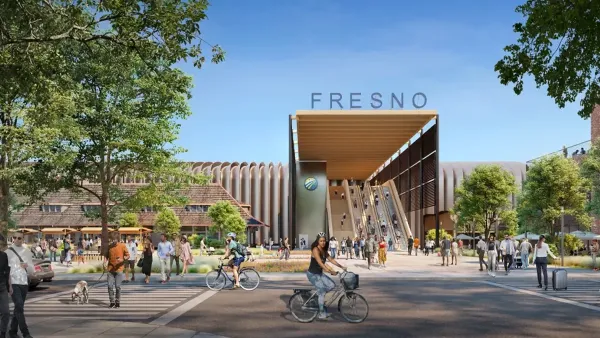
California High-Speed Rail Authority picks trainset manufacturer
The California High-Speed Rail Authority aims to start servicing passengers by 2033.

Planetizen Federal Action Tracker
A weekly monitor of how Trump’s orders and actions are impacting planners and planning in America.

California plans to bury El Niño’s downpour
If the state plays its cards right, it may be able to store a billion acre-feet of El Niño’s water in aquifers.

Desperate measures: Advocates weigh draining Lake Powell to fill Colorado River
Draining the reservoir could reduce evaporation losses by a couple hundred thousand acre-feet.

Housing is the top priority of Seattle’s sole new councilmember
Jenks campaigned on building 1,000 new units of affordable housing.

New tax cuts may slash $1.5 billion in funding for Miami transit, public parks
Amendment 3 will save Miami-Dade homeowners $2,700 in 2028.

Arizona, Wisconsin, Pennsylvania hope to finally advance climate goals post-midterms
The three states have spent years under Republican or divided control.

FREE Course: Walkable City 1: Why Walkability?
After describing his path towards focusing on walkability as the essence of good planning, Jeff Speck marches through his five principal reasons for making more walkable places.
Reinventing Malls: Planning Alchemy—Turning Gray Fields Into Gold
The course focuses on the opportunities and imperatives that shape reinvention of mall sites.

City of Rosemead
Rutgers University, Edward J. Bloustein School of Planning and Public Policy
One Hundred Miles
University of Michigan School for Environment and Sustainability (SEAS)
Hunter College, City University of New York (CUNY)
The Architects Foundation
City of Cambridge
Montrose County
The Pocatello Development Authority