According to a study by U. of Minn's Jason Cao published in the journal, Transportation, there is a positive correlation between living near light rail transit and satisfaction with life. He based it on the Hiawatha light rail line in Minneapolis.


Lindsay Abrams writes that Associate Professor Jason Cao of the Humphrey School of Public Affairs at the University of Minnesota's "found that proximity to good public transit is significantly associated with increased well-being: People who live near rail lines are happier with their lives."
Actually, Cao uses the term, "Satisfaction With Life" in the abstract of his study available in the journal Transportation.
[T]he connections between transit and SWL are mainly conceptual, and little empirical evidence is available in the literature. Using the Hiawatha line in Minneapolis as a case, this study explore(s) the impacts of light rail transit (LRT) on SWL.
Abrams writes that "Cao’s research was based on questionnaires sent out to residents along the Hiawatha [Metro Blue] light rail line in Minneapolis, which he compared to responses from people in other areas of the city."
Eric Jaffe writes in The Atlantic Cities that Cao found that "[p]eople in the Hiawatha corridor had higher ratings on questions related to the quality of their lives compared to people in the other four corridors. These were items like "In most ways my life is close to my ideal" and "The conditions of my life are excellent." In short, they were satisfied with their lives."
While there were many reasons offered for the superior satisfaction by the "Hiawatha" residents, Abrams concludes that what was clear was "that much of the satisfaction derived from living in the Hiawatha corridor comes from the high level of mobility that good light rail provides."
Jaffe points to a prior study that found a similar correlation with rail transit in general.
In his 2011 doctoral dissertation [PDF], the transport scholar Eric Morris (not always a fan of public transportation) found that rail transit had a surprisingly strong connection with personal well-being.
In fact, Jaffe writes that Morris found that accessibility to rail transit "had a greater impact on his or her quality of life than whether or not that person owned a car."
Read the full story: People are happier when they live near public transit

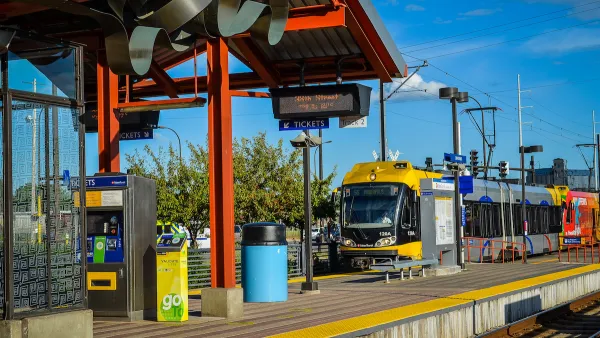
Twin Cities Trains Move to Fewer Cars, Higher Frequency
Headways will drop from 15 minutes to 12 minutes.
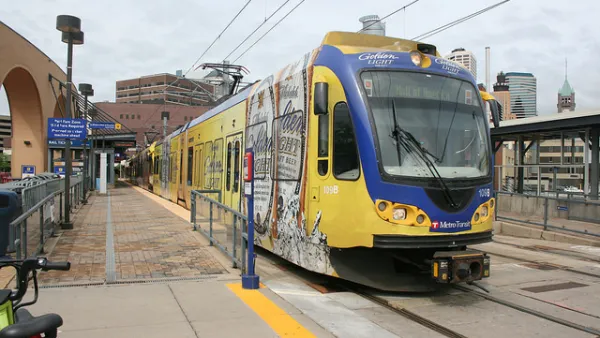
Blue Line Extension North of Minneapolis in Jeopardy
A planned extension of the Metro Blue Line north from Minneapolis depended on eight miles of BNSF track.
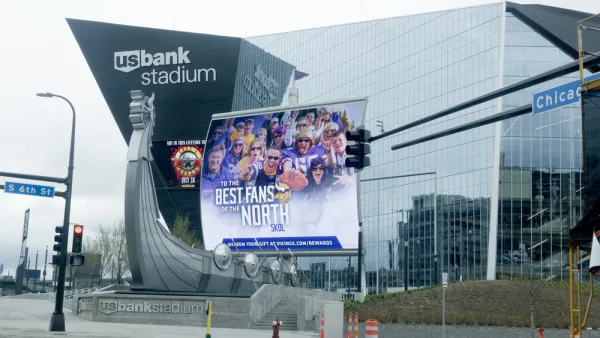
Inside the 2018 Super Bowl's 'Luxified' Venue
When the Eagles and the Patriots face off this weekend, they'll do it at Minneapolis' U.S. Bank Stadium, a billion-dollar venue that "aspires to more than football."

Planetizen Federal Action Tracker
A weekly monitor of how Trump’s orders and actions are impacting planners and planning in America.

California plans to bury El Niño’s downpour
If the state plays its cards right, it may be able to store a billion acre-feet of El Niño’s water in aquifers.

Chicago breaks ground on $3 billion megadevelopment
The new neighborhood, titled Foundry Park, will one day host 3,700 residences.

California High-Speed Rail Authority CEO resigns after $600,000 scandal
Under Ian Choudri, the authority used taxpayer dollars to fund first class flights and trips to nightclubs.

Want to study the Missouri River? Soon, you may need unanimous approval from 10 states
Legislation would require 10 governors’ permission to study or build projects moving water outside the basin.

Desperate measures: Advocates weigh draining Lake Powell to fill Colorado River
Draining the reservoir could reduce evaporation losses by a couple hundred thousand acre-feet.

FREE Course: Walkable City 1: Why Walkability?
After describing his path towards focusing on walkability as the essence of good planning, Jeff Speck marches through his five principal reasons for making more walkable places.
Reinventing Malls: Planning Alchemy—Turning Gray Fields Into Gold
The course focuses on the opportunities and imperatives that shape reinvention of mall sites.

City of Rosemead
Rutgers University, Edward J. Bloustein School of Planning and Public Policy
One Hundred Miles
Hunter College, City University of New York (CUNY)
The Architects Foundation
University of Cincinnati Online
City of Cambridge
Montrose County
The Pocatello Development Authority