It's a scandal fit for an Olympic track and field event or the Tour de France. Performance enhancing features such as spires and other non-occupiable "vanity height" elements are skewing the ranking of the world's tallest buildings.


"It turns out that most of the world’s tallest buildings are doing the architectural equivalent of wearing platform shoes," writes Gwynn Guilford. "That is, they’re scraping skies courtesy of dozens—sometimes hundreds—of meters of 'vanity height,' says a new report (pdf) by the Council on Tall Buildings and Urban Habitat (CTBUH), first spotted by io9."
According to the report, 61% of the world's "supertall" buildings need help to achieve that status, with the Burj al Arab in Dubai revealed as the biggest cheater of that group. New York City, it turns out, is a prime offender. The city will have three of the “tallest 10 Vanity Heights” when One World Trade Center is completed next year.
So what is being done to clean up the competition you ask? Though the organization that's identified the phenomenon is the same one that is "the arbiter of the criteria upon which tall building height is measured", CTBUH hasn't indicated if or how they plan to level the playing field.
Read the full story: 44 of the world’s 72 tallest buildings are cheating
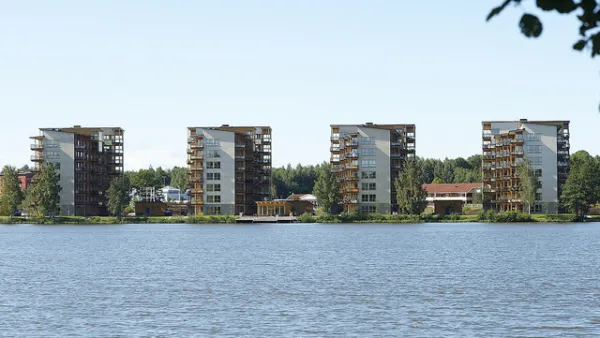
'Tall Timber' May Be the Future of Building
Mass timber is a major structural element of an increasing number of skyscrapers, according to a CTBUH survey; now, the fire codes just have to follow.
Is One World Trade America's Tallest Building? Depends Who You Ask
Spire or antenna; what sits atop One World Trade Center in Lower Manhattan? The answer isn't just semantics, it will determine if the building is indeed taller than Chicago's Willis Tower. A decision by the official arbiter could come next week.
Best Towers of 2012 Recognized
It seems a bit early in the year to be bestowing "best of" honors, but that hasn't stopped the Council on Tall Buildings and Urban Habitat (CTBUH) from naming their best tall buildings of 2012. These towers are certainly worth paying attention to.

Desperate measures: Advocates weigh draining Lake Powell to fill Colorado River
Draining the reservoir could reduce evaporation losses by a couple hundred thousand acre-feet.

Eastern Nebraska is running out of electricity
Data centers and electrification are straining eastern Nebraska’s grid, throttling economic development.

Malls are becoming the midtowns of the future
Mall and office park redevelopments are a generational opportunity to create new nodes of urbanity.

NYC breaks ground on anti-flooding infrastructure project
New York City's new system will reduce stormwater flows to local sewers by 90%.

One Kentucky town’s secret to affordable housing
The Smoketown Community Land Trust has already built seven affordable homes for community members.

Houston gains petal-shaped cooling infrastructure to make streets more ‘delightful’
The city has installed the pavilions along 15 blocks in Houston.

FREE Course: Walkable City 1: Why Walkability?
After describing his path towards focusing on walkability as the essence of good planning, Jeff Speck marches through his five principal reasons for making more walkable places.
Reinventing Malls: Planning Alchemy—Turning Gray Fields Into Gold
The course focuses on the opportunities and imperatives that shape reinvention of mall sites.

City of Rosemead
Rutgers University, Edward J. Bloustein School of Planning and Public Policy
One Hundred Miles
University of Michigan School for Environment and Sustainability (SEAS)
Hunter College, City University of New York (CUNY)
The Architects Foundation
City of Cambridge
Montrose County
The Pocatello Development Authority