Rowan Moore profiles Zaha Hadid, the polarizing architect who's benefited exceedingly from the global appeal of "iconic" architecture. Has the thrust of her pioneering early work been lost amid the astonishing growth of her practice?


"Over the past decade or so [Hadid] has gone from being the Architect Who Never Got Anything Built to someone who can't stop building," writes Moore. "At the turn of the millennium she was still best known for winning at an early age the competition to design the Peak in Hong Kong, a leisure complex that was never realised, and for her martyrdom in Cardiff. . . . Now her office boasts 400 staff and 950 projects in 44 countries. Their work includes colossal developments in Changsha, China, and in Bratislava, a large luxury villa in Moscow and a role advising on the airport that Boris Johnson would like to build in the Thames Estuary."
Moore chronicles some of the personal and professional dramas that have contributed to her mythology - the extraordinary demands, the stories of projects won and lost, and the stunning designs.
"Behind these stories questions recur: does her success, her associations with the mighty, her splendour, mean that she is losing touch with the complexities and contradictions that were once part of her work? Is she now in danger of favouring the spectacular to the exclusion of the dirty realities of cities, in which she used to profess an interest? If she has been dominating/generous, and grand/earthy, is the first half of each pairing now ascendant?"
Read the full story: Zaha Hadid: queen of the curve
Zaha Hadid, Trailblazing and World-Renowned Architect, Dies at 65
Zaha Hadid's architectural career took her to the pinnacle of the field, including acknowledgement as the first female Pritzker Prize winner.
Zaha Hadid's $2 Billion Tokyo Stadium Plans Scrapped
Japan has pulled the plug on an ambitious stadium plan, expected to cost $2 billion and designed by one of the world's most famous architects.
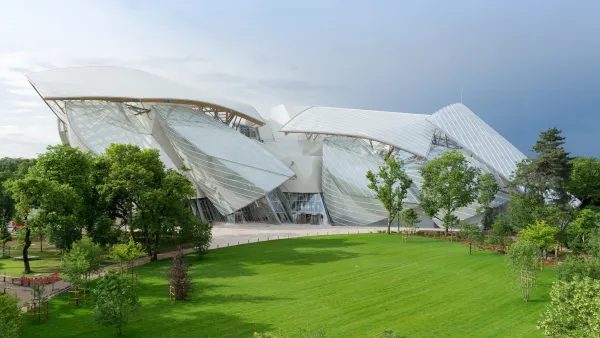
Op-Ed: Starchitecture Fails the Future
An addiction to spectacle and fad, says Peter Buchanan, has set architecture adrift in a sea of meaningless forms. And real design problems go ignored.

Desperate measures: Advocates weigh draining Lake Powell to fill Colorado River
Draining the reservoir could reduce evaporation losses by a couple hundred thousand acre-feet.

Eastern Nebraska is running out of electricity
Data centers and electrification are straining eastern Nebraska’s grid, throttling economic development.

Malls are becoming the midtowns of the future
Mall and office park redevelopments are a generational opportunity to create new nodes of urbanity.

NYC breaks ground on anti-flooding infrastructure project
New York City's new system will reduce stormwater flows to local sewers by 90%.

One Kentucky town’s secret to affordable housing
The Smoketown Community Land Trust has already built seven affordable homes for community members.

Houston gains petal-shaped cooling infrastructure to make streets more ‘delightful’
The city has installed the pavilions along 15 blocks in Houston.

FREE Course: Walkable City 1: Why Walkability?
After describing his path towards focusing on walkability as the essence of good planning, Jeff Speck marches through his five principal reasons for making more walkable places.
Reinventing Malls: Planning Alchemy—Turning Gray Fields Into Gold
The course focuses on the opportunities and imperatives that shape reinvention of mall sites.

City of Rosemead
Rutgers University, Edward J. Bloustein School of Planning and Public Policy
One Hundred Miles
University of Michigan School for Environment and Sustainability (SEAS)
Hunter College, City University of New York (CUNY)
The Architects Foundation
City of Cambridge
Montrose County
The Pocatello Development Authority