Moscow's Gorky Park, once the rundown backdrop of a murder novel, has experienced a remarkable turnaround. Today, the mayor imagines its recovery as part of his legacy while Muscovites simply see it as the perfect place to play, dine, and relax.


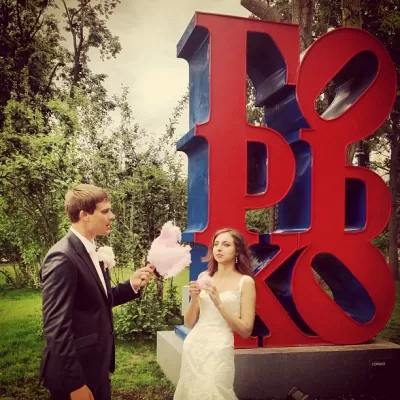
"Long a drab concrete repository of secondhand carnival rides, Gorky Park has been transformed over the past two years into one of the most extravagant, exuberant and excessive urban recreational spaces in a major world capital. Imprinted in many Western minds by the Soviet-era crime novel and film of the same name, Gorky Park celebrates its 85th anniversary this month. It is not only a park in the leafy retreat sense, but also a psychic respite from the increasingly tense political pressures of modern Russia," writes David M. Herszenhorn.
"Beyond the gardens for strolling and the ponds for paddle-boating, the park in its current form is instead an entertainment destination with more than a dozen restaurants, two dance platforms, an outdoor movie theater, and Garage, a buzzy modern arts center housing an exhibition hall and concert space."
"There are basketball and tennis courts, and many Ping-Pong tables, but the park also embraces extreme sports in a way that would thrill personal injury lawyers in the West, with places for skating, bicycle jumping, skateboarding and the obstacle-course bounding of parkour and free-running. There is also beach volleyball (thanks to tons of trucked-in sand) and even pétanque, the French bocce, played nonstop outside a cafe that could have been imported directly from Provence."
"Mayor Sergei S. Sobyanin, who is running for re-election, counts rejuvenating the city’s parks as one of his main achievements, and he has an even bigger, multimillion-dollar renovation planned that will connect Gorky to several other parks for a green belt along much of the Moscow River."
Read the full story: Gorky Park, Once Drab, Now Glows
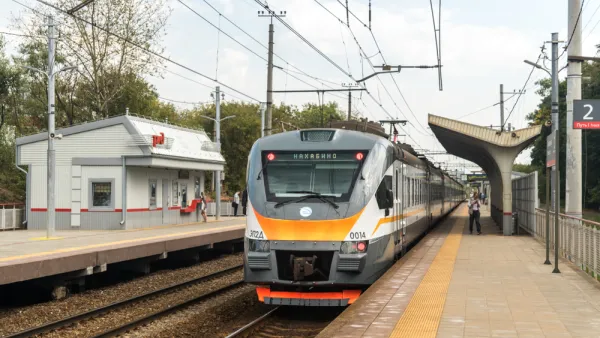
A New Suburban Rail System for Moscow
Two of a planned five new suburban rail routes, modeled on examples in Paris and Berlin, opened last week in Russia.
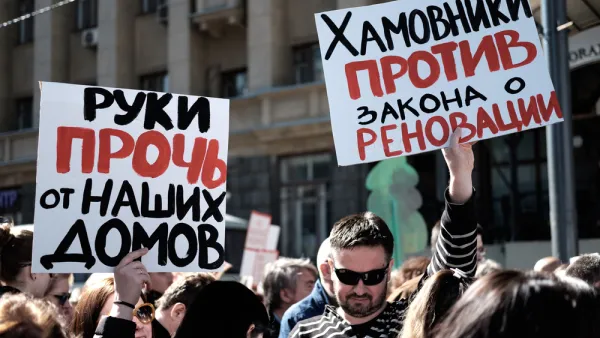
Muscovites Revolt Against Relocation Plan
Plans to decommission existing public housing blocks and replace them with newer high-rises has angered middle-class residents in Moscow who fear the loss of their homes and investments.
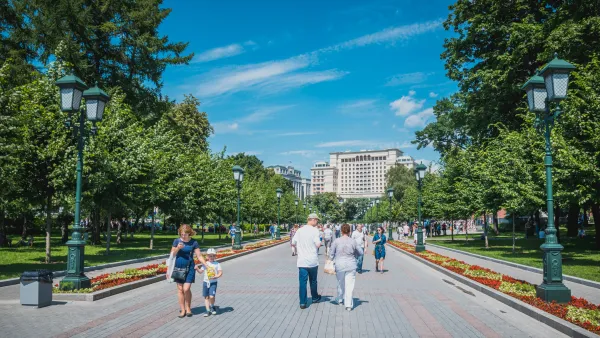
Moscow's Erratic Shift Towards a Walkable City
Moscow's Mayor has pushed an agenda to beautify the city, create social spaces, and make the city more walkable, but critics see the move towards walkability as more of a forced march.

Planetizen Federal Action Tracker
A weekly monitor of how Trump’s orders and actions are impacting planners and planning in America.

California plans to bury El Niño’s downpour
If the state plays its cards right, it may be able to store a billion acre-feet of El Niño’s water in aquifers.

Desperate measures: Advocates weigh draining Lake Powell to fill Colorado River
Draining the reservoir could reduce evaporation losses by a couple hundred thousand acre-feet.

Los Angeles just elected an urban planner as its mayor
Transportation analysts are optimistic that Raman will be more aggressive in addressing transit issues than Bass.

Mamdani’s pied-à-terre tax survives legal challenge
A panel of judges found that the plaintiffs failed to demonstrate injury as a result of New York City's implementation of the tax.

Eastern Nebraska is running out of electricity
Data centers and electrification are straining eastern Nebraska’s grid, throttling economic development.

FREE Course: Walkable City 1: Why Walkability?
After describing his path towards focusing on walkability as the essence of good planning, Jeff Speck marches through his five principal reasons for making more walkable places.
Reinventing Malls: Planning Alchemy—Turning Gray Fields Into Gold
The course focuses on the opportunities and imperatives that shape reinvention of mall sites.

City of Rosemead
Rutgers University, Edward J. Bloustein School of Planning and Public Policy
One Hundred Miles
University of Michigan School for Environment and Sustainability (SEAS)
Hunter College, City University of New York (CUNY)
The Architects Foundation
City of Cambridge
Montrose County
The Pocatello Development Authority