While Tongva Park's design may not be as bold as what James Corner has demonstrated on other projects or initially envisioned here, we should celebrate its planning, execution, and political sophistication, says Christopher Hawthorne.


"The British-born Corner and his New York firm Field Operations have just finished their first major project in California. The $46.1-million park covers seven acres just west of Santa Monica City Hall, two blocks from the beach."
Despite a design approach that he calls "soft-pedaling", Hawthorne praises the park for being "a rare example of farsighted urban planning in Southern California, which may in the end be its most important legacy."
"Santa Monica is ready to unveil an ambitious new public space more than two years before the completion of the second phase of the Expo Line, whose final stop, at 4th Street and Colorado Avenue, will be just two blocks away," he explains. "Certainly the park is poised to be hugely popular both as a place to walk and as a shady refuge from the lively, aggressive commercialism of the pier and nearby Third Street Promenade."
Read the full story: Review: Nature sinks its roots into Santa Monica's new parks
Santa Monica Unearths Its Civic Heart
Terry Pristin examines two pivotal projects currently under construction in Santa Monica that are poised to reconnect the city's historic civic center to the vibrant, walkable beachfront community.
An In-Depth Look at One of America's Preeminent Landscape Architects
The Atlantic's Eric Jaffe centers on James Corner's latest work in Cleveland's Public Square, and goes to describe his other well-known projects, including the High Line, and transformations of public parks and urban spaces throughout the country.
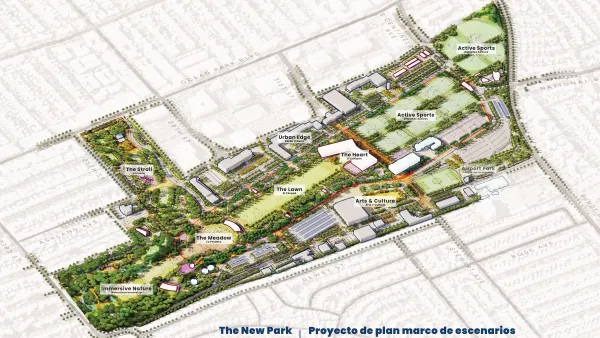
CA city to shut down airport, transform it into utopian park
The western side of the 200-acre park will feature a dog park, nature education center and arboretum.

Planetizen Federal Action Tracker
A weekly monitor of how Trump’s orders and actions are impacting planners and planning in America.

California plans to bury El Niño’s downpour
If the state plays its cards right, it may be able to store a billion acre-feet of El Niño’s water in aquifers.

Desperate measures: Advocates weigh draining Lake Powell to fill Colorado River
Draining the reservoir could reduce evaporation losses by a couple hundred thousand acre-feet.

Los Angeles just elected an urban planner as its mayor
Transportation analysts are optimistic that Raman will be more aggressive in addressing transit issues than Bass.

Mamdani’s pied-à-terre tax survives legal challenge
A panel of judges found that the plaintiffs failed to demonstrate injury as a result of New York City's implementation of the tax.

Eastern Nebraska is running out of electricity
Data centers and electrification are straining eastern Nebraska’s grid, throttling economic development.

FREE Course: Walkable City 1: Why Walkability?
After describing his path towards focusing on walkability as the essence of good planning, Jeff Speck marches through his five principal reasons for making more walkable places.
Reinventing Malls: Planning Alchemy—Turning Gray Fields Into Gold
The course focuses on the opportunities and imperatives that shape reinvention of mall sites.

City of Rosemead
Rutgers University, Edward J. Bloustein School of Planning and Public Policy
One Hundred Miles
University of Michigan School for Environment and Sustainability (SEAS)
Hunter College, City University of New York (CUNY)
The Architects Foundation
City of Cambridge
Montrose County
The Pocatello Development Authority