Philadelphia's police force has increased the proportion of police on foot in its most violent neighborhoods. Not everyone likes the new presence, but the change has has achieved remarkable reductions in violent crime.



"Philadelphia’s foot-patrol strategy was developed after a study in 2009 by criminologists from Temple University, which is in the 22nd district. A randomised trial overturned the conventional view that foot patrols make locals like the police more and fear crime less, but do not actually reduce crime. In targeted areas, violent crime decreased by 23%," explains The Economist.
"Such patrols work best if officers return to the same street several times in each shift, says Jerry Ratcliffe, director of Temple’s Centre for Security and Crime Science. A good officer will soon know everybody on his beat. It is important to 'spend time just standing on a street corner, chatting to people, getting a feel for the tempo and rhythm of a place.' Foot patrols work best in dense neighbourhoods, says Mr. Ratcliffe, where many people cannot afford air conditioning and so socialise on the street. Drunken disagreements beget violence. 'Half the people shot in Philadelphia are shot within two blocks of their address,' he says."
Read the full story: Boots on the street

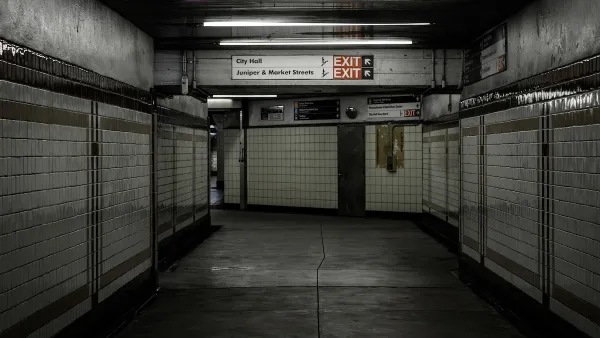
How Does Air Quality in a Philly Subway Station Compare to the Outdoors?
A team of researchers found much higher levels of particulate matter inside the City Hall subway station than on the street-level sidewalks directly above the station.

The Messy Politics of Saving Lives from Drug Overdoses
Philadelphia was on the verge of approving a key harm reduction strategy to prevent fatal drug overdoses until the city council all but banned supervised injection sites, overriding a mayoral veto. A New York Times report explores the controversy.
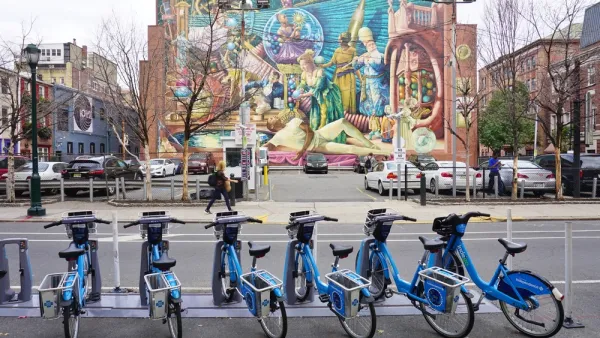
Study: Bikeshare Boosts Riding in Philadelphia
Public health researchers outline the benefits of Philadelphia’s Indego bikeshare network, which has encouraged more residents to choose biking over other transit modes.

Planetizen Federal Action Tracker
A weekly monitor of how Trump’s orders and actions are impacting planners and planning in America.

The state-sanctioned urbicide of Austin
People don’t kill cities. Freeways do.

Colorado’s Largest Data Center Could Rise Next to Homes — Without a Public Hearing
The proposed campus would consume 11 times the power of Denver International Airport; as it has across the country, opposition mounts.

Judges permit Denver to divert 77,000 acre feet from the Colorado River for reservoir expansion
Overuse and climate change have caused the Colorado River’s water levels to plummet.

Amtrak, CN end decades-long dispute with eight-year agreement
The new operating agreement establishes an updated framework for the companies to work together, including processes to resolve disputes.
Raised interest rates may kill financially vulnerable construction projects
The chief economist at ConstructConnect warns that if construction project owners are negatively impacted by the raised rates, it could result in delayed payments to contractors.

FREE Course: Walkable City 1: Why Walkability?
After describing his path towards focusing on walkability as the essence of good planning, Jeff Speck marches through his five principal reasons for making more walkable places.
Reinventing Malls: Planning Alchemy—Turning Gray Fields Into Gold
The course focuses on the opportunities and imperatives that shape reinvention of mall sites.

Greater Baltimore Committee
Eagle County Government
Harvard University Graduate School of Design
The Architects Foundation
University of Cincinnati Online
The Pocatello Development Authority
The Urban Renewal Agency of the City of Pocatello
Journal of the American Planning Association