Public health researchers outline the benefits of Philadelphia’s Indego bikeshare network, which has encouraged more residents to choose biking over other transit modes.


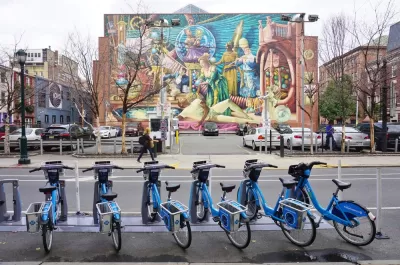
New research from Drexel University suggests that Philadelphia’s Indego bikeshare system has increased physical activity in residents, reports Marcus Biddle for WHYY. “The school’s Urban Health Collaborative collected data from 1,031 newly enrolled bikeshare members, and found that overtime, individuals were cycling at an average of 20 minutes per day.”
The study also looked at equity among bikeshare users, said Amy Auchincloss, associate professor at Drexel’s Department of Epidemiology and Biostatistics. “Close to 25% of participants in her study were Black and Latino with a median age of 30-years old, and an average income of $35,000 per year,” Biddle writes.
Auchincloss says the long-term future of biking in the city depends on the availability of safe bike infrastructure, which Auchincloss says “is not consistently conducive to biking.” Without more investment in connectivity and safety, riders could be discouraged from continuing to use the system. “Some folks are making the plunge and getting on bikes, but many of them are dropping out and are not using bikes at the level that we would hope at a sustained level.”
Read the full story: Study finds Philly’s bikeshare program got more people riding

The Public Health Benefits of Bike Share, Quantified
New research shows that bike share use has a positive impact on public health, even in less bikeable cities.
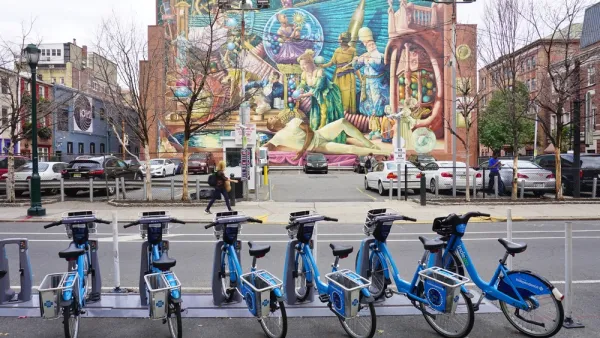
Philadelphia's Indego Bikeshare System Reports Equity Successes in its Second Year
With the help of grant funded infrastructure and community outreach programs, Philadelphia's Indego bikeshare system has shown impressive leadership in equitable bikeshare.
How Does Air Quality in a Philly Subway Station Compare to the Outdoors?
A team of researchers found much higher levels of particulate matter inside the City Hall subway station than on the street-level sidewalks directly above the station.

Planetizen Federal Action Tracker
A weekly monitor of how Trump’s orders and actions are impacting planners and planning in America.

California plans to bury El Niño’s downpour
If the state plays its cards right, it may be able to store a billion acre-feet of El Niño’s water in aquifers.

Chicago breaks ground on $3 billion megadevelopment
The new neighborhood, titled Foundry Park, will one day host 3,700 residences.

Satanic Place Names
From streams and lakes to valleys and canyons, I mapped more than 1,000 places named after the Devil.

California High-Speed Rail Authority CEO resigns after $600,000 scandal
Under Ian Choudri, the authority used taxpayer dollars to fund first class flights and trips to nightclubs.

Want to study the Missouri River? Soon, you may need unanimous approval from 10 states
Legislation would require 10 governors’ permission to study or build projects moving water outside the basin.

FREE Course: Walkable City 1: Why Walkability?
After describing his path towards focusing on walkability as the essence of good planning, Jeff Speck marches through his five principal reasons for making more walkable places.
Reinventing Malls: Planning Alchemy—Turning Gray Fields Into Gold
The course focuses on the opportunities and imperatives that shape reinvention of mall sites.

City of Rosemead
Rutgers University, Edward J. Bloustein School of Planning and Public Policy
One Hundred Miles
Hunter College, City University of New York (CUNY)
The Architects Foundation
University of Cincinnati Online
City of Cambridge
Montrose County
The Pocatello Development Authority