America's oil and gas boom has energy companies ramping up their ability to export natural gas, and the feds eager to approve export terminal projects. But Dow Chemical’s chief executive warns that exports threaten the U.S. manufacturing renaissance.


"[Dow Chemical’s chief executive, Andrew N. Liveris] is spearheading a public campaign against increased exports of natural gas, which he sees as a threat to a manufacturing renaissance in the United States, not to mention his own company’s bottom line," report Clifford Krauss and Nelson D. Schwartz. "But many others say such exports would provide far more benefits to the country than drawbacks, all part of a transformation that promises to increase the nation’s weight in the global economy."
"The battle over natural gas exports reflects just how starkly the nation’s economic landscape is being reshaped by newfound energy supplies — much of the discoveries in the form of oil and gas being freed up by unconventional methods like horizontal drilling combined with hydraulic fracturing," they add. "By 2020, new oil and gas production could increase the country’s economic output by 2 to 4 percent beyond what it otherwise would be, add as many as 1.7 million jobs and perhaps reduce the bill for energy imports to zero, according to a report by the McKinsey Global Institute."
"But that windfall is at risk if the government permits natural gas exports to increase quickly, Mr. Liveris warns."
Read the full story: Foreseeing Trouble in Exporting Natural Gas

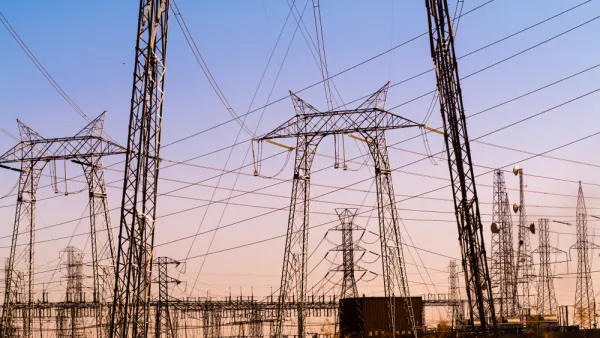
Power Demand is Surging in US
The U.S. has entered a new power paradigm according to a new energy analysis that warns of unprecedented new demands for power, largely from “new manufacturing, industrial, and data center facilities,” and the grid is not prepared for the surge.
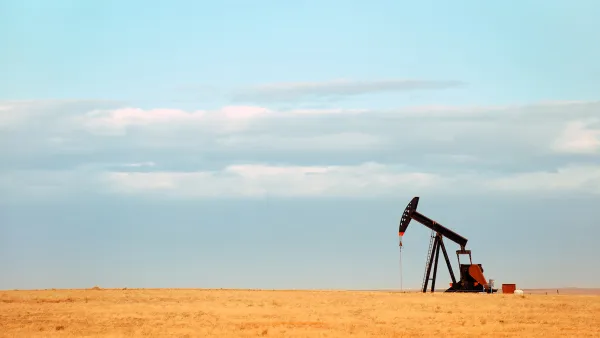
Do Environmentalists Confuse Oil Production With Oil Demand?
Samantha Gross, the director of the Energy Security and Climate Initiative at the Brookings Institution, argues that the key to reducing emissions is to do the hard work of reducing oil demand rather than focusing on ending U.S. oil drilling.
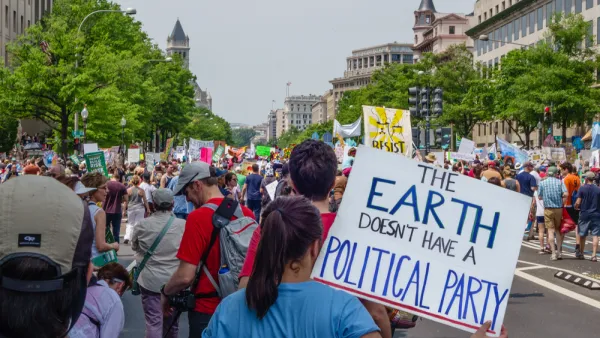
Has the Rug Been Pulled Out From Under Environmentalists?
Robinson Meyer, a climate reporter for The Atlantic, writes about the awkward place American environmentalists find themselves due in part to the war in Europe that has created an international energy crisis and historically high fuel prices at home.

Planetizen Federal Action Tracker
A weekly monitor of how Trump’s orders and actions are impacting planners and planning in America.

Amtrak, CN end decades-long dispute with eight-year agreement
The new operating agreement establishes an updated framework for the companies to work together, including processes to resolve disputes.

Judges permit Denver to divert 77,000 acre feet from the Colorado River for reservoir expansion
Overuse and climate change have caused the Colorado River’s water levels to plummet.

NYC DOT wants faster, more permanent street upgrades
The city is examining ways to build more concrete infrastructure without getting entangled in 'decades-long' projects.

'Something we’ve never seen before:' rising utility rates could strain city finances nationwide
Data centers, climate change and other factors have caused utility rates in the United States to increase by 38% since 2020.

Trump to overrule local leaders, lease millions of acres of America’s Pacific Island territories’ seafloors to mining companies
International law says that the Indigenous people of America’s territories have a right to prior and informed consent regarding projects that impact their countries.

FREE Course: Walkable City 1: Why Walkability?
After describing his path towards focusing on walkability as the essence of good planning, Jeff Speck marches through his five principal reasons for making more walkable places.
Reinventing Malls: Planning Alchemy—Turning Gray Fields Into Gold
The course focuses on the opportunities and imperatives that shape reinvention of mall sites.

Harvard University Graduate School of Design
KFH Group Inc.
Greater Baltimore Committee
The Architects Foundation
University of Cincinnati Online
The Pocatello Development Authority
The Urban Renewal Agency of the City of Pocatello