As the Keystone XL pipeline project remains mired in political muck, a second pipeline project is quietly moving toward approval.


Pipeline builder Enbridge, Inc., has been working on a project for a slightly smaller pipeline that would carry 660,000 barrels of crude from the Alberta tar sands to the Gulf by 2015. Over three-quarters of the 774-mile Eastern Gulf pipeline comprises a repurposed natural gas pipeline, which means that much of it is already built.
While the Keystone XL pipeline has engendered vocal opposition, the Eastern Gulf pipeline has largely gone unnoticed. But that doesn’t mean there isn't reason to be concerned. In fact, the Eastern Gulf line is only one small part of a 5,000-mile oil transport network being built by Enbridge.
“The recent news about the latest hitches for the Keystone XL pipeline may have cheered its opponents,” Thomas Stackpole writes. “But they’re going to have to start thinking a lot bigger if they want to block further tar-sands oil development entirely."
Read the full story: The Keystone XL pipeline alternative you've never heard of is probably going to be built

Developer Drops Keystone XL Plans
It's the latest turn of the screw for a project that has depended on the occupant in the White House.
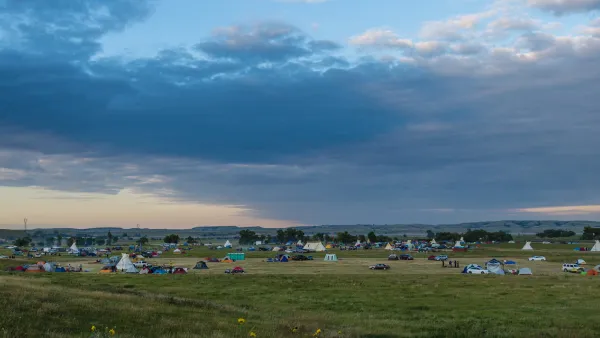
Thank Indigenous Activists for the Keystone XL Pipeline's Demise
President Biden's executive order may put the final nail in the coffin of the controversial pipeline project, but it was unwavering local activists who kept the pressure on for a decade.

Trump Signs Two Executive Orders Limiting States' Authority Over Energy Pipelines
The Trump administration's "energy dominance" agenda depends, in part, on growing the energy distribution network, namely pipelines, rail facilities, and ports. However, states can use the Clean Water Act to block pipelines and coal terminals.

Planetizen Federal Action Tracker
A weekly monitor of how Trump’s orders and actions are impacting planners and planning in America.

California plans to bury El Niño’s downpour
If the state plays its cards right, it may be able to store a billion acre-feet of El Niño’s water in aquifers.

Desperate measures: Advocates weigh draining Lake Powell to fill Colorado River
Draining the reservoir could reduce evaporation losses by a couple hundred thousand acre-feet.

Mamdani’s pied-à-terre tax survives legal challenge
A panel of judges found that the plaintiffs failed to demonstrate injury as a result of New York City's implementation of the tax.

Eastern Nebraska is running out of electricity
Data centers and electrification are straining eastern Nebraska’s grid, throttling economic development.

Seattle passes record-breaking transit services expansion
Proposition 1 will double the city’s transit tax to add 95,000 more bus trips and preserve 180,000 bus trips annually.

FREE Course: Walkable City 1: Why Walkability?
After describing his path towards focusing on walkability as the essence of good planning, Jeff Speck marches through his five principal reasons for making more walkable places.
Reinventing Malls: Planning Alchemy—Turning Gray Fields Into Gold
The course focuses on the opportunities and imperatives that shape reinvention of mall sites.

City of Rosemead
Rutgers University, Edward J. Bloustein School of Planning and Public Policy
One Hundred Miles
University of Michigan School for Environment and Sustainability (SEAS)
Hunter College, City University of New York (CUNY)
The Architects Foundation
City of Cambridge
Montrose County
The Pocatello Development Authority