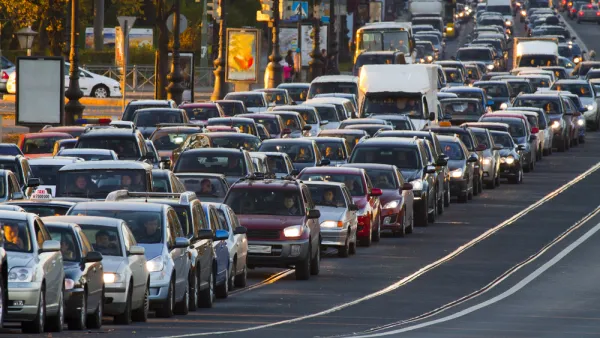
Planners and environmentalists have applauded the seven-year decline in America's auto ownership levels with understandable enthusiasm. But around the world, automobile production has never been higher.


"Two weeks ago, transportation researcher Michael Sivak brought us the news that there are fewer cars per person in the U.S. now than there were a few years ago – and that the number isn’t expected to rise again," writes Tanya Snyder. "But globally, the trend is in the opposite direction, and it’s alarming. The world is producing more cars than ever."
"The troubling new reality," she explains, "is that while the United States and other developed countries are beginning to lay off the gas, other countries are accelerating wildly. Though the U.S. still has by far the largest fleet of passenger cars, auto sales in China overtook the U.S. in 2011. In 2010, the number of cars in the world hit one billion."
"The number of cars per person in the U.S. has been declining since 2006. But in other countries, the trend is ever upward."
Read the full story: Car Ownership May Be Down in the U.S., But It’s Soaring Globally

Peak Motorization: Measuring Rates of Auto Ownership and Distances Driven
Passenger vehicle ownership and vehicle miles traveled per person and per household remain below their historic peaks set in 2006 and 2004, respectively, but they have been on the upswing for the past four to five years, according to new data.
From Taxi Industry Disrupter to Auto Industry Disrupter
Car ownership is far from "a thing of the past," as Uber's CEO plans on making it, but a new survey shows that a substantial number of people who have tried transportation network companies are forgoing the purchase of a car.

Peak Car? Check Your Data
There is evidence that automobile travel is peaking while demand for non-auto modes is growing, but double-check your data sources to be sure.

Planetizen Federal Action Tracker
A weekly monitor of how Trump’s orders and actions are impacting planners and planning in America.

California plans to bury El Niño’s downpour
If the state plays its cards right, it may be able to store a billion acre-feet of El Niño’s water in aquifers.

Chicago breaks ground on $3 billion megadevelopment
The new neighborhood, titled Foundry Park, will one day host 3,700 residences.

Desperate measures: Advocates weigh draining Lake Powell to fill Colorado River
Draining the reservoir could reduce evaporation losses by a couple hundred thousand acre-feet.

This road in NYC is infamously dangerous — and Mamdani can't fix it
New York City's Ocean Parkway is known for reckless driving, but the power to implement safety measures lies with the state rather than the city.

One of Denver’s busiest corridors to gain BRT
The project will span 18 miles and contain 74 bus rapid transit stations.

FREE Course: Walkable City 1: Why Walkability?
After describing his path towards focusing on walkability as the essence of good planning, Jeff Speck marches through his five principal reasons for making more walkable places.
Reinventing Malls: Planning Alchemy—Turning Gray Fields Into Gold
The course focuses on the opportunities and imperatives that shape reinvention of mall sites.

City of Rosemead
Rutgers University, Edward J. Bloustein School of Planning and Public Policy
One Hundred Miles
Hunter College, City University of New York (CUNY)
The Architects Foundation
University of Cincinnati Online
City of Cambridge
Montrose County
The Pocatello Development Authority