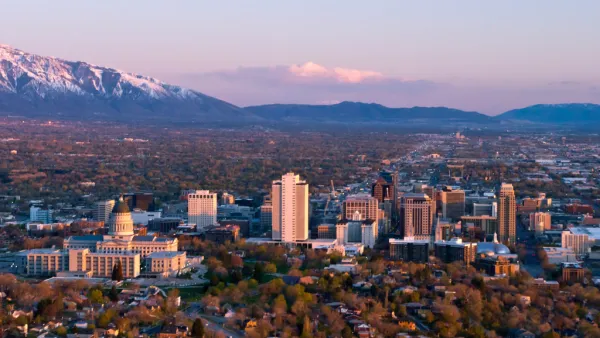
It's remote, it's small, and it's situated in a decidedly red state. So why in the world does Salt Lake City lead the U.S. in per-capita transit spending? Angie Schmitt explains the city's unlikely story.


"It’s number one in the nation in per-capita transit spending. The only city in the country building light rail, bus rapid transit, streetcars and commuter rail at the same time. And that city — Salt Lake City — is a town of just over 180,000 in a remote setting in a red state."
Schmitt recounts the "remarkable story that began in the 1990s, when an organization called Envision Utah facilitated a regional visioning process and created a plan that has been recognized as one of the most promising smart growth models in the nation."
“How is it that the most conservative state… how is it they’re one of the most progressive in the country on transit?” said Dee Allsop of the communications firm Hart and Mind Strategies. “It’s because the case was made in a way that fit with people’s values.”
"The values they settled on were to have a city that was 'beautiful, prosperous and neighborly.'”
Read the full story: Salt Lake City: How a Remote Red-State City Became a Transit Leader

20 Years Later: Envision Utah's Quality Growth Strategy Deemed a Massive Success
The state of Utah created Envision Utah in the late 1990s to address growth while maintaining quality of life and protecting the environment in the state. The plan set goals for 2020, so it's time to evaluate its success.
Bad Air Bedevils Utah
For a state that prides itself on being a nature lovers' paradise, a growing struggle with hazardous air pollution threatens Utah's very identity. Dan Frosch examines the factors contributing to the epidemic, and some of the proposed solutions.

Feds look to Great Salt Lake as a source of rare minerals
A new grant is funding the expansion of non-evaportative lithium extraction from the brackish waters.

Planetizen Federal Action Tracker
A weekly monitor of how Trump’s orders and actions are impacting planners and planning in America.

Amtrak, CN end decades-long dispute with eight-year agreement
The new operating agreement establishes an updated framework for the companies to work together, including processes to resolve disputes.

Northwest rail fans eager for Sept. 30 debut of Amtrak’s Airo fleet
Get ready for that new train smell and more seats. But they won’t go faster or run more frequently on the Cascades route in Washington and Oregon.

Brightline Florida files for bankruptcy
The transit company is over $5 billion in debt.

St. Louis Metro to test if single-car trains can reduce operating costs, maintain rider satisfaction
The pilot program will run from October to spring 2027, and begin with one single-car train operating on Metrolink’s Red and Blue lines.

Pennsylvania is building data centers in abandoned mines
Housing data centers in mines provides an alternative to destroying local forests and may spare residents from data centers’ noise and air pollution.

FREE Course: Walkable City 1: Why Walkability?
After describing his path towards focusing on walkability as the essence of good planning, Jeff Speck marches through his five principal reasons for making more walkable places.
Reinventing Malls: Planning Alchemy—Turning Gray Fields Into Gold
The course focuses on the opportunities and imperatives that shape reinvention of mall sites.

City of Thousand Oaks
City of Wisconsin Rapids
Harvard University Graduate School of Design
The Architects Foundation
University of Cincinnati Online
The Pocatello Development Authority
The Urban Renewal Agency of the City of Pocatello