The long-awaited "Taxi of Tomorrow", which was specifically designed for use in New York City by Nissan, got a workout on the city's streets this week in advance of the fleet's arrival in October.


"Nissan was offering rides, not drives, in its NV200 taxi, which still showed a few signs of being a work in progress," writes Jim Motavalli. "Only one of the rear passenger doors had a sliding window (which rattled when open), and some finishing touches had not yet been completed."
"In a 15-minute ride in the van, some of the taxi’s advantages were apparent. It had limousine-grade legroom, a big roof window to help passengers see the city and separate climate controls for passengers. A handy step emerged when either sliding door was opened. The cabin featured a full-length divider window incorporating a pass-through for payments, as well as a natural-sounding intercom system similar to those in London cabs. The passenger compartment had cup holders, as well as USB ports for recharging cellphones and other devices."
Read the full story: A Ride Around Manhattan in the Taxi of Tomorrow
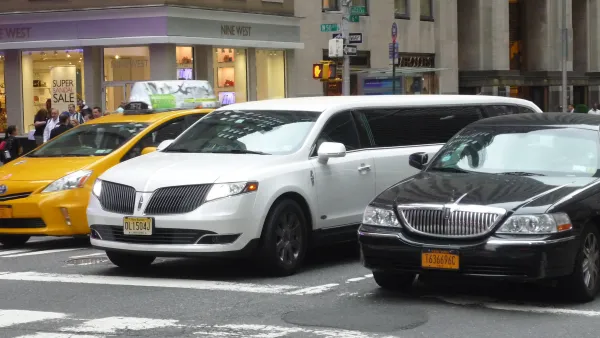
New York Car Service Companies Go Digital
Facing tough competition from Uber, New York City's neighborhood car service providers are using apps to retain clientele. The jury's still out on whether adaptation will help them stay in business.
Taxi of Tomorrow Scuttled Yesterday
Mayor Bloomberg's plan to mandate a standardized taxi for the streets of New York was given a potentially fatal blow this week by a State Supreme Court judge. With his successors unlikely to take up the legal battle, the plan appears doomed.
How Taxis Augment Public Transit
Urban Planning Professor David King has found that rather than working in competition, taxi cabs actually augment public transit networks.

Planetizen Federal Action Tracker
A weekly monitor of how Trump’s orders and actions are impacting planners and planning in America.

California plans to bury El Niño’s downpour
If the state plays its cards right, it may be able to store a billion acre-feet of El Niño’s water in aquifers.

Desperate measures: Advocates weigh draining Lake Powell to fill Colorado River
Draining the reservoir could reduce evaporation losses by a couple hundred thousand acre-feet.

Mamdani’s pied-à-terre tax survives legal challenge
A panel of judges found that the plaintiffs failed to demonstrate injury as a result of New York City's implementation of the tax.

Eastern Nebraska is running out of electricity
Data centers and electrification are straining eastern Nebraska’s grid, throttling economic development.

Seattle passes record-breaking transit services expansion
Proposition 1 will double the city’s transit tax to add 95,000 more bus trips and preserve 180,000 bus trips annually.

FREE Course: Walkable City 1: Why Walkability?
After describing his path towards focusing on walkability as the essence of good planning, Jeff Speck marches through his five principal reasons for making more walkable places.
Reinventing Malls: Planning Alchemy—Turning Gray Fields Into Gold
The course focuses on the opportunities and imperatives that shape reinvention of mall sites.

City of Rosemead
Rutgers University, Edward J. Bloustein School of Planning and Public Policy
One Hundred Miles
University of Michigan School for Environment and Sustainability (SEAS)
Hunter College, City University of New York (CUNY)
The Architects Foundation
City of Cambridge
Montrose County
The Pocatello Development Authority