Zachary Edelson speculates on the ways in which Google Glass, and other augmented reality elements, will change the way we experience architecture and our environments.


"The augmented reality that Google Glass promises may not seem architectural, but in truth the two couldn’t be more related," says Edelson. "Augmented reality is, after all, the layering of information over the built environment." But how will our interpretation of the physical world change when the virtual world becomes a visual part of it?
"You won’t just see a building; you’ll also see any relevant data concerning what’s going on inside that building. We’ll be increasingly aware of the inner happenings of our surroundings in a myriad of ways." Google Glass will let us see beyond architecture, in other words, the ultimate expression of function over form.
"Beyond mere ads it’s difficult to speculate about the profound effects of augmented reality," continues Edelson. "The technology itself is still evolving, but there are hints of what’s to come. We already know how the smartphones Google Glass relies upon have affected us: They increasingly put us into our own world where news, social media, and work are condensed into a very personal device."
"We can assume that augmented reality will further cater to our individuality as it visually surrounds us with personalized attention," he adds. "However, even as we live in our own worlds the information being sent to us will reflect the incredible inter-connectivity of the digital 21st century."
Read the full story: Is Google Glass Going To Change Architecture Forever?

4 Ways to Use AI in Urban Planning and City Design
With the ability to predict trends, engage citizens, enhance resource allocation, and guide decision-making, artificial intelligence has the potential to serve as planners’ very own multi-tool.
Walking Directions, Assisted by Augmented Reality
Augmented reality could boost safety for pedestrians, or it could add another layer of distraction between people and the real world.
Augmented Reality and Public Art: A New Era Begins Today
People in six global cities will have a chance to sample an ambitious new augmented reality program launched by Apple today.

Planetizen Federal Action Tracker
A weekly monitor of how Trump’s orders and actions are impacting planners and planning in America.

Northwest rail fans eager for Sept. 30 debut of Amtrak’s Airo fleet
Get ready for that new train smell and more seats. But they won’t go faster or run more frequently on the Cascades route in Washington and Oregon.
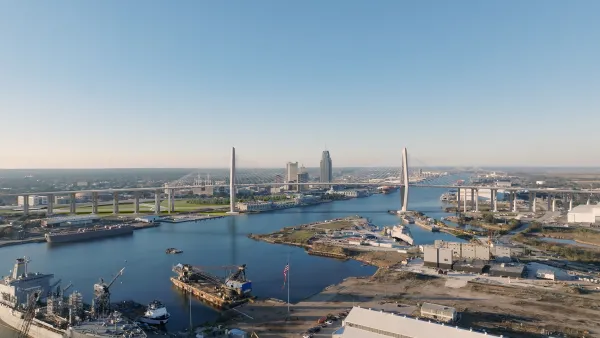
Alabama scores up to $2.5 billion federal loan for largest infrastructure project in state’s history
The Mobile River Bridge and Bayway Project aims to ease congestion at Alabama’s worst bottleneck.

Novel study finds extreme state-by-state disparity in housing construction timelines
The first comprehensive working paper on U.S. construction timelines also found that the permitting process for multi-family projects has slowed nationwide.

California may destroy its beaches trying to save homes from El Niño
Boulders and seawalls can protect homes from waves, but ultimately destroy sandy beaches.

California high-speed rail accomplishes only one legislative goal in 2026
The majority of the agency's failed pitches were never developed into written proposals.

FREE Course: Walkable City 1: Why Walkability?
After describing his path towards focusing on walkability as the essence of good planning, Jeff Speck marches through his five principal reasons for making more walkable places.
Reinventing Malls: Planning Alchemy—Turning Gray Fields Into Gold
The course focuses on the opportunities and imperatives that shape reinvention of mall sites.

City of Thousand Oaks
City of Wisconsin Rapids
Harvard University Graduate School of Design
The Architects Foundation
University of Cincinnati Online
Northern Illinois Transit Authority (NITA)
The Pocatello Development Authority
The Urban Renewal Agency of the City of Pocatello