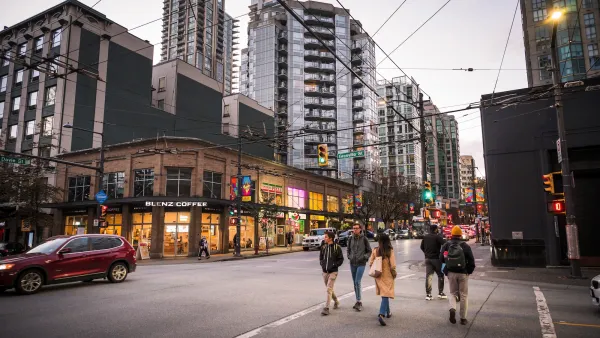
A new Census Bureau report finds population density going down everywhere in the country -- except California, where it's going up in most metropolitan areas, especially smaller ones.



The Census Bureau recently released a new report [PDF] that showed -- by at least one measure -- the nation's overall population density dropped by 6% between 2000 and 2010. But by this same measure, the population density of most California metro areas -- where almost 90% of Californians live -- is going up. And density's going up faster in the smaller counties.
Nationwide, the Census Bureau found that density dropped 6.0% in all metropolitan and micropolitan areas combined, and 5.5% in all metro areas. Of the 377 metro areas in the nation, population density dropped in 232 of them -- more than 60%. But not in California. In the Golden State, the population density of 14 of state's 22 metro areas went up. Population density increased the most -- by far -- in Madera County. Other places that saw population density go up were Shasta, Kings, Napa, Sutter, and the Inland Empire (Riverside and San Bernardino counties combined). Among those metros losing density were Sacramento, San Diego, San Luis Obispo, San Francisco, Los Angeles, and Monterey.
But at more than 12,000 persons per square mile, L.A. and San Francisco remain the densest metro areas in the nation except for New York.
Read the full story: As Usual, California Density Goes Its Own Way -- Up!

To upzone or not to upzone? Two views on the housing crisis
Allowing more density can increase the housing supply, but does the attendant rise in land prices cancel out the benefits?

Less than 6% of California cities are building enough housing for very low-income households
Only five jurisdictions are on track to meet their housing goals for all income brackets.

Controversial Texas housing law has 'directly facilitated' over 1,250 new homes
SB 840 allows developers to build multifamily housing by-right on lots zoned for commercial use without applying to a zoning change.

Planetizen Federal Action Tracker
A weekly monitor of how Trump’s orders and actions are impacting planners and planning in America.

Amtrak, CN end decades-long dispute with eight-year agreement
The new operating agreement establishes an updated framework for the companies to work together, including processes to resolve disputes.

Northwest rail fans eager for Sept. 30 debut of Amtrak’s Airo fleet
Get ready for that new train smell and more seats. But they won’t go faster or run more frequently on the Cascades route in Washington and Oregon.

Brightline Florida files for bankruptcy
The transit company is over $5 billion in debt.

St. Louis Metro to test if single-car trains can reduce operating costs, maintain rider satisfaction
The pilot program will run from October to spring 2027, and begin with one single-car train operating on Metrolink’s Red and Blue lines.

Pennsylvania is building data centers in abandoned mines
Housing data centers in mines provides an alternative to destroying local forests and may spare residents from data centers’ noise and air pollution.

FREE Course: Walkable City 1: Why Walkability?
After describing his path towards focusing on walkability as the essence of good planning, Jeff Speck marches through his five principal reasons for making more walkable places.
Reinventing Malls: Planning Alchemy—Turning Gray Fields Into Gold
The course focuses on the opportunities and imperatives that shape reinvention of mall sites.

City of Thousand Oaks
City of Wisconsin Rapids
Harvard University Graduate School of Design
The Architects Foundation
University of Cincinnati Online
The Pocatello Development Authority
The Urban Renewal Agency of the City of Pocatello