Brian Merchant explores the fascinating history of the California Cycleway, a dedicated bicycling superhighway that was partially constructed beginning in 1897 between Pasadena and downtown Los Angeles.


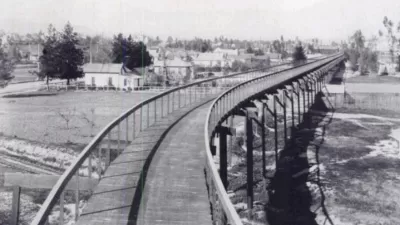
"In 1897, a wealthy American businessman named Horace Dobbins began construction on a private, for-profit bicycle superhighway that would stretch from Pasadena to downtown Los Angeles."
"The notion that anyone could profit off of such a venture—a bicycle toll road—seems insane now. But at the time, bicycling was a full-on fad. As in, something the rich, the hip, and the elite actually wanted to do. There were 30,000 cyclists in the Los Angeles region at the time, which was less populous then; it was home to 500,000 residents. A full 6% of Angelenos were cyclists."
"But alas, the bicycle craze was soon supplanted by the automobile craze, and the elites have never looked back. The cycleway was never completed, and was eventually abandoned. Part of the path cleared for the project was, somewhat ironically, turned into the Arroyo Seco Parkway."
Read the full story: In 1897, a Bicycle Superhighway Was the Future of California Transit

California TOD Law Gives NIMBYs a new Weapon Against Bus Lanes
A new law that allows rezoning for higher density near transit lines is fueling opposition to a Burbank bus rapid transit line.
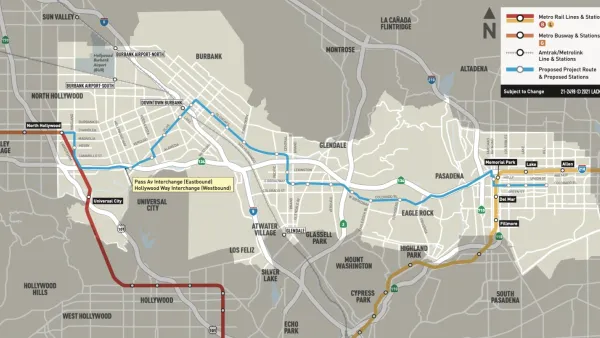
Controversial North Hollywood-Pasadena Bus Rapid Transit Line Approved
A controversial project to connect the San Fernando and San Gabriel valleys by bus rapid transit has final approval. Los Angeles, Glendale, Burbank, and Pasadena will have a new connecting transit line as soon as 2024.
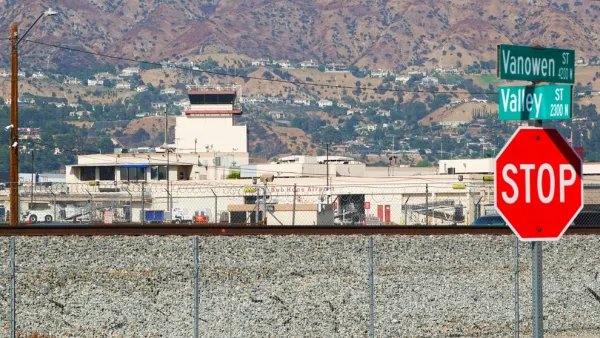
Feasibility Study Approved for Pasadena, Burbank Airport Light Rail Extension
$1 million in new state funding will study the feasibility of connecting the Gold Line light rail in Pasadena to the Hollywood Burbank Airport in Southern California.

Planetizen Federal Action Tracker
A weekly monitor of how Trump’s orders and actions are impacting planners and planning in America.

California plans to bury El Niño’s downpour
If the state plays its cards right, it may be able to store a billion acre-feet of El Niño’s water in aquifers.

Desperate measures: Advocates weigh draining Lake Powell to fill Colorado River
Draining the reservoir could reduce evaporation losses by a couple hundred thousand acre-feet.

Mamdani’s pied-à-terre tax survives legal challenge
A panel of judges found that the plaintiffs failed to demonstrate injury as a result of New York City's implementation of the tax.

Eastern Nebraska is running out of electricity
Data centers and electrification are straining eastern Nebraska’s grid, throttling economic development.

Seattle passes record-breaking transit services expansion
Proposition 1 will double the city’s transit tax to add 95,000 more bus trips and preserve 180,000 bus trips annually.

FREE Course: Walkable City 1: Why Walkability?
After describing his path towards focusing on walkability as the essence of good planning, Jeff Speck marches through his five principal reasons for making more walkable places.
Reinventing Malls: Planning Alchemy—Turning Gray Fields Into Gold
The course focuses on the opportunities and imperatives that shape reinvention of mall sites.


City of Rosemead
Rutgers University, Edward J. Bloustein School of Planning and Public Policy
One Hundred Miles
University of Michigan School for Environment and Sustainability (SEAS)
Hunter College, City University of New York (CUNY)
The Architects Foundation
City of Cambridge
Montrose County
The Pocatello Development Authority