More than a third of the land in our cities is covered by black asphalt, an exemplary heat trapping surface and major contributor to the urban heat island effect. Researchers at Lawrence Berkeley Lab are studying "cool pavement" alternatives.


"To show that there are alternatives to hot asphalt, Lawrence Berkeley Lab, in California, currently has a showcase of 'cool pavements' that are designed to reflect between 30% to 50% of the energy, compared to about 5% for conventional surfaces," reports Ben Schiller. The alternative coatings are being displayed in Berkeley's parking lot for local government officials to see what products are currently on the market.
"[W]ith more than a third of cities taken up with pavement, using cooler coatings could have a big impact on reducing air temperatures and improving air quality," notes Schiller. "Studies have shown that lighter surfaces, combined with more vegetation, could impede the formation of smog, and reduce energy costs--for example, from air conditioning."
Read the full story: Using Different Colored Streets To Keep Our Cities Cool

Heat Islands May Not Be So Bad After All
Emily Badger reports on pioneering research that is looking into ways to utilize the heat trapping properties of asphalt, rather than fighting it.
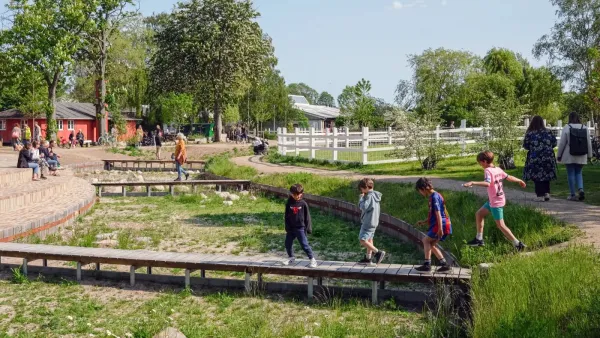
Copenhagen is losing its cool
In a city long designed to maximize light during dark Scandinavian winters, climate change is forcing the Danish capital to rethink its relationship with the sun.
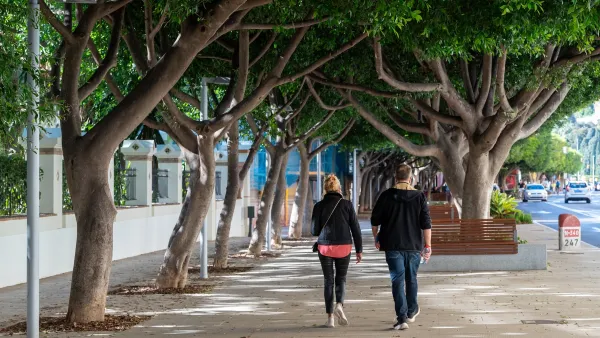
Green blocks are up to 4 degrees cooler than treeless streets
The difference in temperature created by urban trees can translate to as much as 40% less excess heat.

Planetizen Federal Action Tracker
A weekly monitor of how Trump’s orders and actions are impacting planners and planning in America.

Amtrak, CN end decades-long dispute with eight-year agreement
The new operating agreement establishes an updated framework for the companies to work together, including processes to resolve disputes.

Northwest rail fans eager for Sept. 30 debut of Amtrak’s Airo fleet
Get ready for that new train smell and more seats. But they won’t go faster or run more frequently on the Cascades route in Washington and Oregon.

Brightline Florida files for bankruptcy
The transit company is over $5 billion in debt.

St. Louis Metro to test if single-car trains can reduce operating costs, maintain rider satisfaction
The pilot program will run from October to spring 2027, and begin with one single-car train operating on Metrolink’s Red and Blue lines.

Pennsylvania is building data centers in abandoned mines
Housing data centers in mines provides an alternative to destroying local forests and may spare residents from data centers’ noise and air pollution.

FREE Course: Walkable City 1: Why Walkability?
After describing his path towards focusing on walkability as the essence of good planning, Jeff Speck marches through his five principal reasons for making more walkable places.
Reinventing Malls: Planning Alchemy—Turning Gray Fields Into Gold
The course focuses on the opportunities and imperatives that shape reinvention of mall sites.

City of Thousand Oaks
City of Wisconsin Rapids
Harvard University Graduate School of Design
The Architects Foundation
University of Cincinnati Online
The Pocatello Development Authority
The Urban Renewal Agency of the City of Pocatello