A new building at a Mexico City hospital has been screened with an advanced, and quite attractive, tile that breaks down the harmful pollutants in smog into less toxic substances, reports Zak Stone.


"The Torre de Especialidadesis is shielded with a facade of Prosolve370e, a new type of tile whose special shape and chemical coating can help neutralize the chemicals that compose smog: and not just a small amount of them, but the equivalent produced by 8,750 cars driving by each day," writes Stone. "The tile is the first product by Berlin-based design firm Elegant Embellishments, whose co-founder Allison Dring explained to me via email, just exactly how a 100-meter-long tile screen can suck up serious amounts of smog."
Stone explains the chemical process by which the tile's titanium dioxide paint breaks down smog "into small amounts of less noxious chemicals, including calcium nitrate (a salt used in fertilizers), carbon dioxide, and water."
As Stone notes, "[the tiles are] also beautiful, a strategic decision by Elegant Embellishments to attach the technology “to an aesthetic, to be visibly apparent to the public,” Dring offers. “The client, and indeed the general public are aware and live every day with the hazards of pollution--it’s a fairly visible problem in [Mexico City.]”
Read the full story: This Beautiful Mexico City Building Eats The City’s Smog

Vecindades: Mexico City's Answer to 'Missing Middle Housing'
An iconic multifamily housing form repurposes the former homes of Mexico's elite into communal housing for urban workers.

Mexico City Airport Project Ends; Causes Economic Rumblings
Mexican voters do not want the airport project to continue, and serious economic consequences could follow.
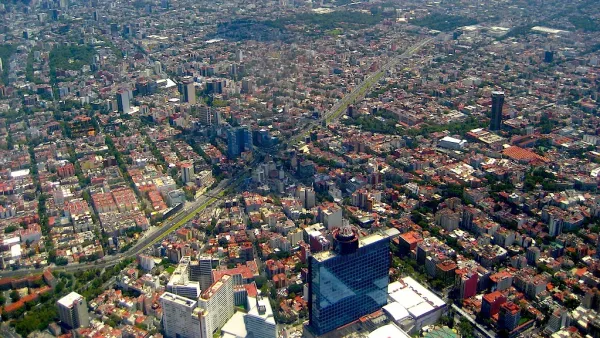
Mexico City Coalition Dreams of Restoring Rivers
A proposal to restore Mexico City's 45 rivers envisions a whole new model for the city.

Planetizen Federal Action Tracker
A weekly monitor of how Trump’s orders and actions are impacting planners and planning in America.

California plans to bury El Niño’s downpour
If the state plays its cards right, it may be able to store a billion acre-feet of El Niño’s water in aquifers.

Desperate measures: Advocates weigh draining Lake Powell to fill Colorado River
Draining the reservoir could reduce evaporation losses by a couple hundred thousand acre-feet.

Los Angeles just elected an urban planner as its mayor
Transportation analysts are optimistic that Raman will be more aggressive in addressing transit issues than Bass.

Mamdani’s pied-à-terre tax survives legal challenge
A panel of judges found that the plaintiffs failed to demonstrate injury as a result of New York City's implementation of the tax.

Eastern Nebraska is running out of electricity
Data centers and electrification are straining eastern Nebraska’s grid, throttling economic development.

FREE Course: Walkable City 1: Why Walkability?
After describing his path towards focusing on walkability as the essence of good planning, Jeff Speck marches through his five principal reasons for making more walkable places.
Reinventing Malls: Planning Alchemy—Turning Gray Fields Into Gold
The course focuses on the opportunities and imperatives that shape reinvention of mall sites.

City of Rosemead
Rutgers University, Edward J. Bloustein School of Planning and Public Policy
One Hundred Miles
University of Michigan School for Environment and Sustainability (SEAS)
Hunter College, City University of New York (CUNY)
The Architects Foundation
City of Cambridge
Montrose County
The Pocatello Development Authority