The USDA's new Food Access Research Atlas provides a handy guide for assisting policymakers and planners in finding the urban and rural areas with the most formidable obstacles to accessing fresh healthy food, reports Nancy Shute.


"The atlas, which is a big upgrade from the USDA's 2-year-old Food Desert Locator, is intended as a tool for state policymakers, local planners and nonprofit groups concerned about food access," says Shute.
"'People can get a more detailed picture of exactly what challenges they encounter in getting to the grocery store,' says Paula Dutko, an economist for the USDA Economic Research Service who helped craft the atlas."
"Food deserts have been a hot target of healthy-eating efforts, including Michelle Obama's Let's Move campaign," adds Shute. "But as programs zero in on improving access, they're finding that bringing in farmers markets and grocery stores doesn't necessarily mean that people start eating better."
"So as our colleague Dan Charles has reported, efforts are now also working on lowering costs, consumer education and marketing."
Read the full story: How To Find A Food Desert Near You
Food Deserts Exaggerated
The "food deserts" problem is receiving heightened attention following the release of the USDA's locator map. But this analysis relies on the suspect premise that suburban supermarkets are superior to small, walkable urban foodsellers.
Making economic sense of city-owned grocery stores
Several cities are moving to create municipal stores, but do they actually save low-income households money?
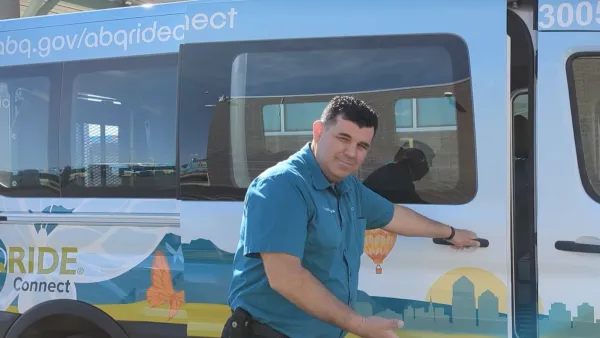
Albuquerque’s Microtransit: A Planner’s Answer to Food Access Gaps
New microtransit vans in Albuquerque aim to close food access gaps by linking low-income areas to grocery stores, cutting travel times by 30 percent and offering planners a scalable model for equity-focused transit.

Washington state to charge fee to drivers with fuel-efficient cars
Revenue from the fee will go towards supporting the state’s highways.

Illinois considers spending $1 billion in taxpayer money on data center
A quantum computing campus and data center are currently under construction in Chicago.

Trump to blast ‘hydrocarbon highway’ through ‘world’s longest art gallery’
Environmental and historic preservation groups are suing to stop the project.

NYC, state sue feds over mixed-immigration-status housing assistance rule
The state’s lawsuit argues that the rule change violates the Administrative Procedure Act.

Michigan to turn neighborhood into virtual power plant
Residents will soon be able to divert their excess energy to the grid in exchange for compensation.

Data center, mining project swarm to long-awaited Alaska railroad line
The state-owned railroad approved final plans for the spur line this week; the project is expected to cost $311 million, mostly funded by the federal government

FREE Course: Walkable City 1: Why Walkability?
After describing his path towards focusing on walkability as the essence of good planning, Jeff Speck marches through his five principal reasons for making more walkable places.
Reinventing Malls: Planning Alchemy—Turning Gray Fields Into Gold
The course focuses on the opportunities and imperatives that shape reinvention of mall sites.

City of Charlotte
City of Rosemead
Rutgers University, Edward J. Bloustein School of Planning and Public Policy
University of Michigan School for Environment and Sustainability (SEAS)
Hunter College, City University of New York (CUNY)
The Architects Foundation
University District Partnership