The semi-finalists competing to design an iconic ‘street seat’ for Boston's growing Innovation District have given "the city a glimpse of what the often-overlooked park bench could be when reconsidered through sustainable, beautiful design."


Emily Badger shares images of the 20 "semi-finalists" selected as part of a design competition for the Fort Point Channel in South Boston, which is being supported by the city and run by the Design Museum Boston. According to the organizers, "The goal of the challenge is to improve the livability of this burgeoning urban area, using design, while being socially and environmentally conscious."
"More than 170 groups from around the world submitted entries to the competition," notes Badger. "All 20 'semi-finalists' are shown in the slideshow below (during the public unveiling on April 27, a selected winner and runner-up from this group will also be given cash awards). These benches were all sustainably designed, many of them using reclaimed local materials. And submissions from as far away as Georgia, Washington state and Italy have found ways to pay homage to Boston's shipping heritage (and the Fort Point Channel scenery), suggesting that the basic park bench could in any city be both infinitely re-imagined and locally distinct."
The semi-finalists have the next month (and $750) to fabricate full-sized versions of their designs, says Badger.
Read the full story: The Humble Public Bench Gets a Dramatic Makeover
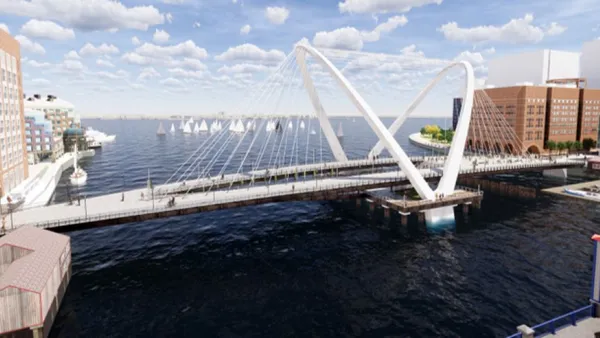
New North Avenue Bridge in Boston Would Ban Cars
The "people first" design favored by the city of Boston would not allow for cars on the planned North Avenue Bridge replacement.
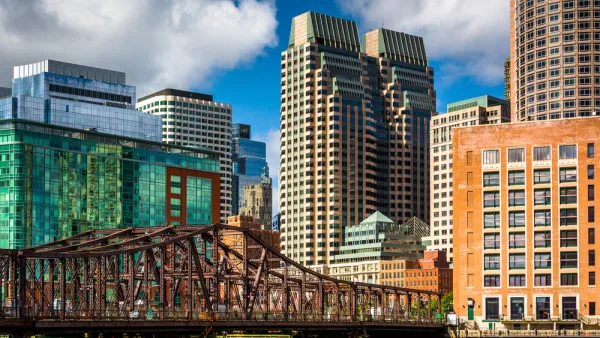
Boston Plans Park Network for Resilience and Revitalization
The city hopes to accelerate development and mitigate flood risk along the industrial Fort Point Channel with a string of new parks.
Popularity Threatens Progress in Boston's Booming Seaport District
With growth ten years ahead of estimates, Boston's Innovation District is in need of some fresh ideas to help stave of death by traffic asphyxiation. Local roads and mass transit are already stretched to capacity during the evening commute.

Planetizen Federal Action Tracker
A weekly monitor of how Trump’s orders and actions are impacting planners and planning in America.

California plans to bury El Niño’s downpour
If the state plays its cards right, it may be able to store a billion acre-feet of El Niño’s water in aquifers.

Desperate measures: Advocates weigh draining Lake Powell to fill Colorado River
Draining the reservoir could reduce evaporation losses by a couple hundred thousand acre-feet.

Housing is the top priority of Seattle’s sole new councilmember
Jenks campaigned on building 1,000 new units of affordable housing.

New tax cuts may slash $1.5 billion in funding for Miami transit, public parks
Amendment 3 will save Miami-Dade homeowners $2,700 in 2028.

Arizona, Wisconsin, Pennsylvania hope to finally advance climate goals post-midterms
The three states have spent years under Republican or divided control.

FREE Course: Walkable City 1: Why Walkability?
After describing his path towards focusing on walkability as the essence of good planning, Jeff Speck marches through his five principal reasons for making more walkable places.
Reinventing Malls: Planning Alchemy—Turning Gray Fields Into Gold
The course focuses on the opportunities and imperatives that shape reinvention of mall sites.

City of Rosemead
Rutgers University, Edward J. Bloustein School of Planning and Public Policy
One Hundred Miles
University of Michigan School for Environment and Sustainability (SEAS)
Hunter College, City University of New York (CUNY)
The Architects Foundation
City of Cambridge
Montrose County
The Pocatello Development Authority