Looking to get out from under one of the primary factors for financial distress - pension obligations - city leaders across the United States are viewing bankruptcy as "a valuable tool in a city’s financial toolbox," reports Liz Farmer.


According to Farmer, "A handful of California cities are now using bankruptcy to take on that state’s goliath pension system; the outcomes of those cases could spread far beyond California, changing the way other municipalities view bankruptcy. Filing for Chapter 9 will almost certainly remain a decision of last resort, but the stigma may not be what it once was. There’s a growing sense among some leaders that municipal bankruptcy -- unthinkable just a few years ago -- may be a valuable tool in a city’s financial toolbox."
The bankruptcy of Central Falls, R.I., which allowed the town of 20,000 people to make cuts to its labor and retiree agreements it had long fought for, is seen as an important precedent for cities pushing for pension reform.
“Up until Central Falls, there was never what we call an ‘or else,’” says Ted Orson, the attorney for the city’s receiver. “There wasn’t any leverage to make concessions. However, after Central Falls, when [the labor unions] saw what happened, they understood it’s better to negotiate a better agreement than to be in a position where something can be forced on you and you might not like what it is.”
"Central Falls showed cities that pensions were touchable," says Farmer. "Now, two cases in California could cement that idea into law."
"If a judge rules that pension systems can indeed be treated like other creditors -- many expect the case to make its way to the U.S. Supreme Court -- it could forever change the notion of municipal bankruptcy and fiscal restructuring."
Read the full story: The 'B' Word: Is Municipal Bankruptcy's Stigma Fading?

The Well Has Run Dry: Redevelopment in Vallejo, CA Without Tax Increment Financing
A case study of Vallejo shows how the city is continuing revitalization efforts without the powerful tools provided by its former redevelopment agency.
Signs of Recovery? Stockton, California Exits Bankruptcy
Stockton, California symbolized the worst effects of the Great Recession on local governments—not to mention, to some, California's decline.
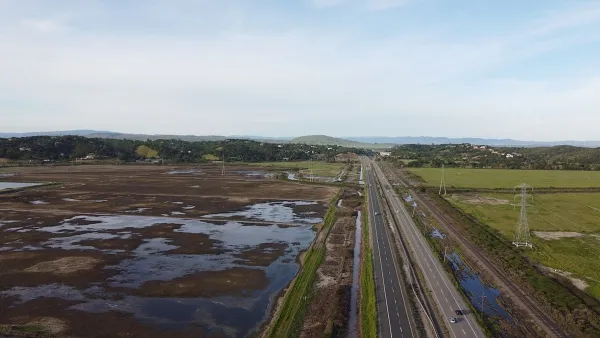
Sinking Into Wetlands, This Northern California Highway Needs a Rescue
A plan to elevate the roadway and restore adjacent wetlands could take decades to complete.

Planetizen Federal Action Tracker
A weekly monitor of how Trump’s orders and actions are impacting planners and planning in America.

California plans to bury El Niño’s downpour
If the state plays its cards right, it may be able to store a billion acre-feet of El Niño’s water in aquifers.

Desperate measures: Advocates weigh draining Lake Powell to fill Colorado River
Draining the reservoir could reduce evaporation losses by a couple hundred thousand acre-feet.

Mamdani’s pied-à-terre tax survives legal challenge
A panel of judges found that the plaintiffs failed to demonstrate injury as a result of New York City's implementation of the tax.

Eastern Nebraska is running out of electricity
Data centers and electrification are straining eastern Nebraska’s grid, throttling economic development.

Seattle passes record-breaking transit services expansion
Proposition 1 will double the city’s transit tax to add 95,000 more bus trips and preserve 180,000 bus trips annually.

FREE Course: Walkable City 1: Why Walkability?
After describing his path towards focusing on walkability as the essence of good planning, Jeff Speck marches through his five principal reasons for making more walkable places.
Reinventing Malls: Planning Alchemy—Turning Gray Fields Into Gold
The course focuses on the opportunities and imperatives that shape reinvention of mall sites.

City of Rosemead
Rutgers University, Edward J. Bloustein School of Planning and Public Policy
One Hundred Miles
University of Michigan School for Environment and Sustainability (SEAS)
Hunter College, City University of New York (CUNY)
The Architects Foundation
City of Cambridge
Montrose County
The Pocatello Development Authority