CA Gov. Jerry Brown stated he had big plans in his State of the State speech on Jan 24. Thanks to temporary tax increases under Prop 30 and spending cuts, the budget is finally balanced. Yet he also called for 'fiscal constraint' - contradictory?


Jerry Roberts and Phil Trounstein lay out Brown's hopes for California - and his legacy in his third term as governor (he served from 1975-1983 following Ronald Reagan). Brown staked much on Proposition 30 in the November election - a temporary increase in the sales and top tier income tax - and the result is an expected $6 billion increase in revenue, thus ending the structural deficit that resulted when his predecessor, Arnold Schwarzenegger reversed the vehicle license fee increase - creating a $6 billion deficit.
Brown made no bones about his fiscally conservative impulse. “We have promises to keep. And the most important is the one we made to the voters if Proposition 30 passed: that we would guard jealously the money temporarily made available,” he said.
“This means living within our means and not spending what we don’t have. Fiscal discipline is not the enemy of our good intentions but the basis for realizing them.
He may have been directing those words to his fellow Democrats who now control a super-majority in both legislative houses, thus making tax increase possible without the help of Republicans who had even prevented his placing Prop 30 on the ballot as a legislative initiative - he had to raise the funds and place it as a citizens initiative.
Yet while calling for fiscal constraint, he made his plans clear for significant infrastructure improvement. He "sees this moment in California history – where water, rail and the environment pose huge challenges and opportunities (much like the ones his father faced in the 1960s) – as part of an unbroken strand of Golden State history..."
To 'think big':
- "California should approve Brown’s plan to tunnel water from the San Joaquin Delta to critical economic regions of the state.
- California must set its sights on getting at least a third of its electricity from solar, wind and other renewable sources by 2020.
- California must build a high-speed rail system."
Robert and Trounstein sum-up by writing that "(t)hese are the kinds of bold projects that link today’s legislators with the grand history of California, Brown was saying. Whether the governor has the skill and clout to lead Sacramento toward his vision of its destiny is uncertain."
However, starting off with a balanced budget - the first one with no gimmicks since his predecessor created a $6 billion structural deficit, is a good way to start.
To listen to an abbreviated or the entire speech, see KQED's "Jerry Brown's State of the State Speech in 7, 15 and 30 Minutes".
Read the full story: What Brown Told the Legislature About CA’s Destiny

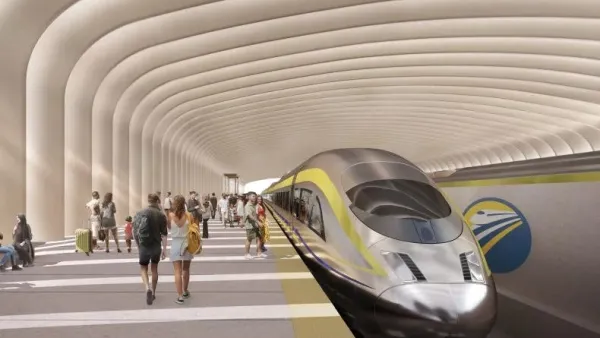
California High-Speed Rail's Plan to Right Itself
The railroad's new CEO thinks he can get the project back on track. The stars will need to align this summer.
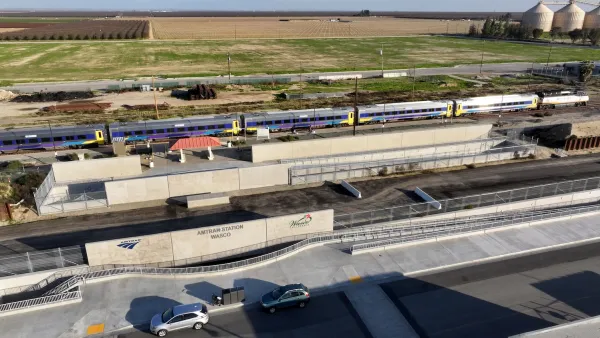
Trump: Federal Government Won’t Pay for California HSR
The President has targeted federal funding for the California bullet train project since his first administration.
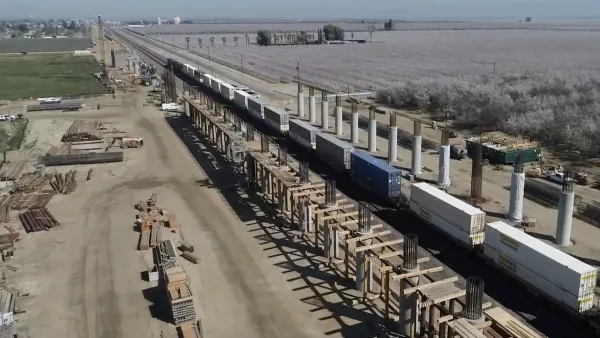
California HSR Could Be Up and Running by 2033
A newly restructured leadership promises to speed up the arduous construction process and start running trains in five to eight years.

Planetizen Federal Action Tracker
A weekly monitor of how Trump’s orders and actions are impacting planners and planning in America.

Amtrak, CN end decades-long dispute with eight-year agreement
The new operating agreement establishes an updated framework for the companies to work together, including processes to resolve disputes.
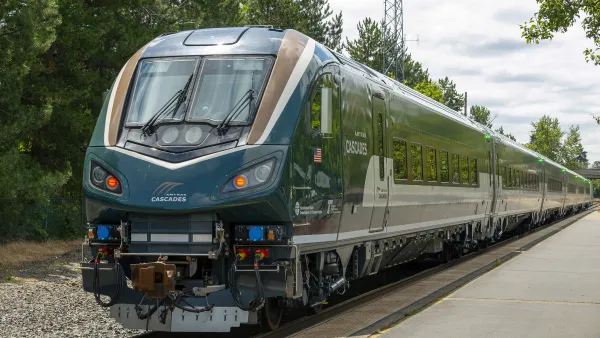
Northwest rail fans eager for Sept. 30 debut of Amtrak’s Airo fleet
Get ready for that new train smell and more seats. But they won’t go faster or run more frequently on the Cascades route in Washington and Oregon.

LAX SkyLink opening delayed again, contractor won’t commit to new deadline
The project was supposed to open its doors to the public in 2023.

Caltrain may slash over one-third of its stations
If Bay Area voters reject two transit tax measures, Caltrain, BART and AC Transit will see steep service cuts.

A 'dangerous' precedent: North Carolina successfully pressures communities into voting for toll roads
Two mayors resigned from the Charlotte Regional Transportation Planning Organization after it voted in favor of the toll roads.

FREE Course: Walkable City 1: Why Walkability?
After describing his path towards focusing on walkability as the essence of good planning, Jeff Speck marches through his five principal reasons for making more walkable places.
Reinventing Malls: Planning Alchemy—Turning Gray Fields Into Gold
The course focuses on the opportunities and imperatives that shape reinvention of mall sites.

City of Thousand Oaks
City of Wisconsin Rapids
Harvard University Graduate School of Design
The Architects Foundation
University of Cincinnati Online
The Pocatello Development Authority
The Urban Renewal Agency of the City of Pocatello