Howard Blackson's "Next Urbanism Lab" series looks at recent trends and lessons learned for urban designers. While the Bilbao Effect, the Vancouver Model, the High Line, and Active Living may provide seductive role models, local insight is key.


"In not learning from the past we are destined to repeat it. So, in this lab, I’ll examine some of the trends currently dominating planning and begin examining the quirks and pitfalls that can occur when a solution for one city is transplanted somewhere else," says Blackson.
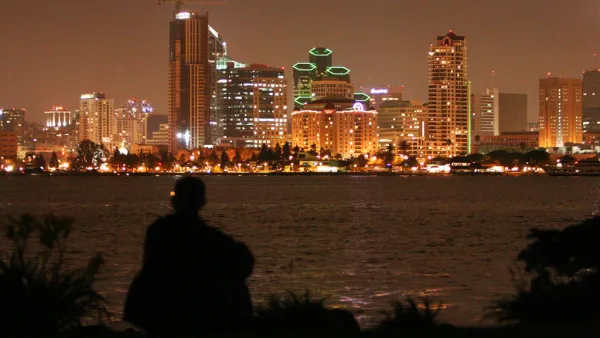
"In my last Next Urbanism Lab post, I detailed how my city of San Diego has been built over time through a layering of national planning and development trends — silver bullets, so to speak — in order to chase economic prosperity. Our new convention center, downtown baseball park, mall, and freeway were squished into our traditional urban fabric in order to save our city from some economic malaise at the time."
Blackson goes on to point out that San Diego is still in the red and still following the latest trends: the Bilbao Effect, the Vancouver Model, the High Line, and Active Living. Instead of mimicking these planning innovations, he looks for the placemaking lessons that each has to offer. And how we might bring them home.
Read the full story: Next Urbanism Lab 02: Planning Trends Captivate, but…

Is Your City an Innovator or a Follower?
Howard Blackson walks through the planning layers of San Diego for a history lesson as well as a look to the Next Urbanism.
Neighborhoods First (and Goal)
Howard Blackson's words of advice for San Diego's new administration are applicable wherever it is you call home. Neighborhoods first!
Dare to Live Outdoors
The old cool: Sealing yourself inside suburban air conditioning. The new cool? According to Howard Blackson, it's the joy to be found outside, connecting with one another and the world we share.

Planetizen Federal Action Tracker
A weekly monitor of how Trump’s orders and actions are impacting planners and planning in America.

California plans to bury El Niño’s downpour
If the state plays its cards right, it may be able to store a billion acre-feet of El Niño’s water in aquifers.

Chicago breaks ground on $3 billion megadevelopment
The new neighborhood, titled Foundry Park, will one day host 3,700 residences.

California High-Speed Rail Authority CEO resigns after $600,000 scandal
Under Ian Choudri, the authority used taxpayer dollars to fund first class flights and trips to nightclubs.

Want to study the Missouri River? Soon, you may need unanimous approval from 10 states
Legislation would require 10 governors’ permission to study or build projects moving water outside the basin.

Desperate measures: Advocates weigh draining Lake Powell to fill Colorado River
Draining the reservoir could reduce evaporation losses by a couple hundred thousand acre-feet.

FREE Course: Walkable City 1: Why Walkability?
After describing his path towards focusing on walkability as the essence of good planning, Jeff Speck marches through his five principal reasons for making more walkable places.
Reinventing Malls: Planning Alchemy—Turning Gray Fields Into Gold
The course focuses on the opportunities and imperatives that shape reinvention of mall sites.

City of Rosemead
Rutgers University, Edward J. Bloustein School of Planning and Public Policy
One Hundred Miles
Hunter College, City University of New York (CUNY)
The Architects Foundation
University of Cincinnati Online
City of Cambridge
Montrose County
The Pocatello Development Authority