Will Hunt explores Paris beneath the surface during a 14-mile trek underground with a group of urban explorers, and finds subterranean sights to rival those found on the famous streets above.


"Our aim is to examine the city's connection to its underground in a way
no one has before: we will attempt to walk from the southern edge to the
northern, using only catacombs, telecom tunnels, sewers and other
hidden infrastructure. It is a 14-mile trek, every step illegal. The six
of us-five Americans and an Australian-are prepared for a two- or
three-day journey, with nights sleeping in the bowels of Paris. We have
packed food, sleeping bags, an arsenal of flashlights and headlamps, and
gas meters to alert us to any poisonous fumes in the sewers. It will be
urban troglodytism, a walkabout in the wilderness under the city."
"Just as visitors to the surface of Paris follow a sight-seeing
itinerary-Sacré Coeur, Notre Dame, the Eiffel Tower-so do visitors to
its underside. Wandering through the alcoves connected to La Plage, we
visit a room with a Norman castle and rock-hewn gargoyles, a room heaped
with silk flowers, a room lined with paintings of film characters. We
encounter four separate groups of cataphiles. On a weekend night, La
Plage is as crowded as most Parisian bars."
Thanks to Daniel Lippman
Read the full story: GOING SOUTERRAIN
Exploring the Catacombs of Paris
Beneath Paris is an underground network of tunnels and quarries, long closed to the public. National Geographic takes a tour of this forbidden part of the city, where urban explorers keep tradition alive.
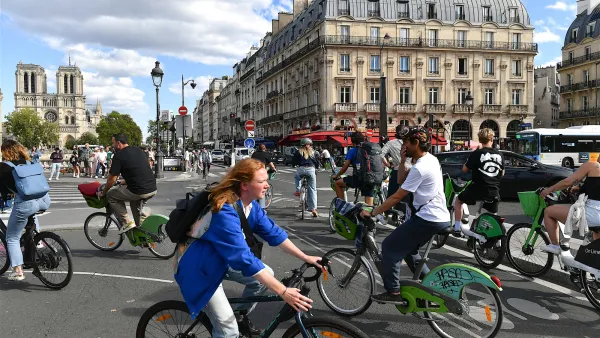
Biking in Paris grew by 240% in 5 years
The city saw a significant rise in bike use thanks to data-driven policy changes.
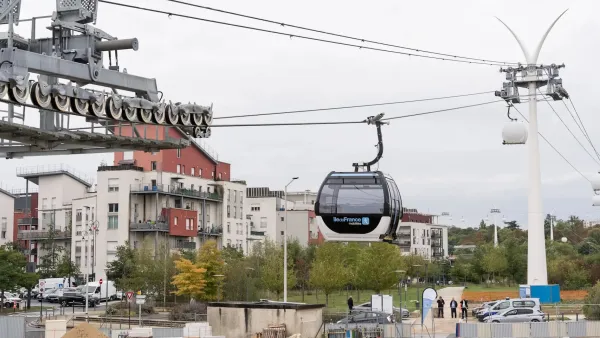
Paris Opens Europe’s Longest Aerial Gondola Line
The new cable car line, France’s seventh, is expected to carry roughly 11,000 passengers per day.

Planetizen Federal Action Tracker
A weekly monitor of how Trump’s orders and actions are impacting planners and planning in America.

California plans to bury El Niño’s downpour
If the state plays its cards right, it may be able to store a billion acre-feet of El Niño’s water in aquifers.

Desperate measures: Advocates weigh draining Lake Powell to fill Colorado River
Draining the reservoir could reduce evaporation losses by a couple hundred thousand acre-feet.

Los Angeles just elected an urban planner as its mayor
Transportation analysts are optimistic that Raman will be more aggressive in addressing transit issues than Bass.

Mamdani’s pied-à-terre tax survives legal challenge
A panel of judges found that the plaintiffs failed to demonstrate injury as a result of New York City's implementation of the tax.

Eastern Nebraska is running out of electricity
Data centers and electrification are straining eastern Nebraska’s grid, throttling economic development.

FREE Course: Walkable City 1: Why Walkability?
After describing his path towards focusing on walkability as the essence of good planning, Jeff Speck marches through his five principal reasons for making more walkable places.
Reinventing Malls: Planning Alchemy—Turning Gray Fields Into Gold
The course focuses on the opportunities and imperatives that shape reinvention of mall sites.

City of Rosemead
Rutgers University, Edward J. Bloustein School of Planning and Public Policy
One Hundred Miles
University of Michigan School for Environment and Sustainability (SEAS)
Hunter College, City University of New York (CUNY)
The Architects Foundation
City of Cambridge
Montrose County
The Pocatello Development Authority