The intersection of Yonge and Harbour is just one example of the dangerous conditions that confront Toronto’s pedestrians daily. Are the police to blame for the city’s lack of pedestrian safety?


After a 24-hour period last week when 11 Toronto area pedestrians were struck by cars, Christopher Hume criticizes the city's police and transportation policies for placing more importance on cars than on pedestrian safety. "From Chief Bill Blair down to the cop on the street," he says, "the police force's contempt for pedestrians knows no bounds. For Toronto's finest, pedestrians don't exist, at least not until they are involved in accidents, at which point, they get all the attention they no longer need."
The intersection at Tonge and Harbour, where "[t]he current configuration, intended to keep vehicular traffic moving, makes few concessions to walkers" and "[t]he police, of course, remain utterly oblivious" is just one example of transportation policies and police attitudes that view pedestrians as little more than "sacrificial lambs" and "collateral damage" argues Hume.
"At the same time, thousands now live in the condo towers popping up around this intersection," he adds. "Five residential highrises have already appeared near the corner, and more are in the works. Like the rest of us, their inhabitants have kids and dogs and expect to be able to cross the road with a reasonable hope of making it in one piece."
Thanks to Jessica Hsu
Read the full story: Hume: Toronto cops ignore pedestrians
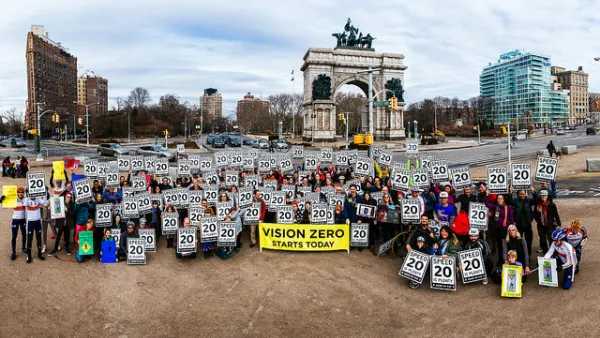
Zero Traffic Deaths Isn't as Far Fetched as It Sounds
Even supporters of Vision Zero—a goal to eliminate traffic fatalities from roadways adopted by cities and states all over the United States—doubt that such lofty ambitions are possible. But there are plenty of reasons to believe in the cause.
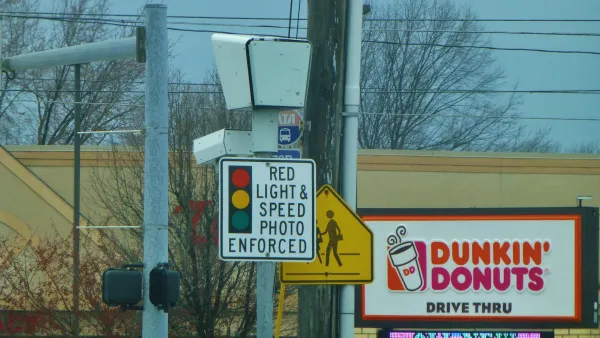
Toronto Ready to Implement as Ontario Legalizes Photo Speed Enforcement
The city of Toronto needed regulatory permission from the province of Ontario to begin enforcing speed limits with the use of automated camera technology. Photo radar in Ontario is legal as of today.
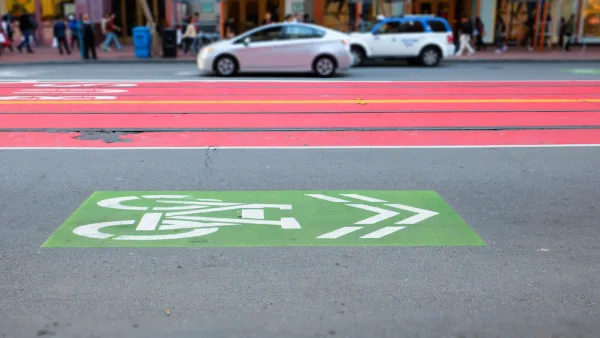
Lack of Traffic Safety Enforcement Blamed for Vision Zero Failures
Education, engineering, and enforcement are the three "e's" of Vision Zero in San Francisco. A lack of on of those "e's"—enforcement—might explain why more people are dying on the city's streets this year that any year since the city adopted Vision Z

Planetizen Federal Action Tracker
A weekly monitor of how Trump’s orders and actions are impacting planners and planning in America.

Eastern Nebraska is running out of electricity
Data centers and electrification are straining eastern Nebraska’s grid, throttling economic development.

Study reveals best places in the U.S. for cycling, walking
New research from Streetlight Data examines bicycle and pedestrian miles per capita in the 100 largest U.S. cities by population.

DSA members accuse Mamdani of 'abandoning values' over housing redevelopment
New York City's mayor plans to replace about 2,000 units of public housing with private, mixed-income housing.

All sides of BRT debate unhappy with CDOT’s most recent move
The Colorado Department of Transportation is no longer considering center-running bus lanes for Colorado Boulevard.

Massachusetts bogs generate both power, and cranberries
Putting solar panels above farmland is one way Massachusetts is advancing toward its goal of net-zero carbon emissions by 2050.

FREE Course: Walkable City 1: Why Walkability?
After describing his path towards focusing on walkability as the essence of good planning, Jeff Speck marches through his five principal reasons for making more walkable places.
Reinventing Malls: Planning Alchemy—Turning Gray Fields Into Gold
The course focuses on the opportunities and imperatives that shape reinvention of mall sites.

City of Rosemead
Rutgers University, Edward J. Bloustein School of Planning and Public Policy
One Hundred Miles
University of Michigan School for Environment and Sustainability (SEAS)
Hunter College, City University of New York (CUNY)
The Architects Foundation
City of Cambridge
The Pocatello Development Authority
The Urban Renewal Agency of the City of Pocatello