Despite recent controversy that claimed the BeltLine Inc’s president, when the 2.25-mile Eastside Trail opens this week, Atlanta's long-awaited Beltline will take its “most significant step forward yet,” reports Bill Torpy.


The vision for converting an abandoned railway corridor circling downtown Atlanta into a network of public parks, multi-use trails and transit - known as the BeltLine - began life as a doctoral thesis by Georgia Tech student Ryan Gravel in 1999. With Monday's opening of the Eastside Trail, Gravel's vision, which saw its transit plan take a hit with the rejection of a proposed transit sales tax in July, is facing another reality check.
"Ed McBrayer, executive director of PATH, the organization
charged with the corridor's construction oversight, calls this section 'a big first step. This will be a model case to see if the Beltline can
be all that we think it can be,' he said. 'This starts a network we've
been looking for, for 20 years. It will be a trail connecting Fernbank
to Centennial Park (downtown) to the MLK Center, to Piedmont Park to
Freedom Parkway. You can travel to a lot of destinations that mean
something.'"
Also, McBrayer added, "This section will either prove
or disprove that economic development will follow greenspace as we think
it might."
Read the full story: Beltline a walk in the park

Atlanta Beltline Acquires Major Piece of the Future Eastside Trail
The Atlanta Beltline will be realized one step at a time, and this was a big one.

Atlanta City Council unanimously backs $3.5 billion Beltline light rail project
The resolution was drafted after Atlanta Mayor Andre Dickens pulled support for the Atlanta Streetcar extension last year.
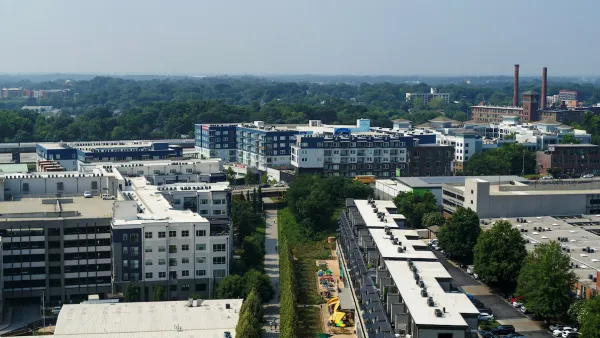
New Study Commissioned for Atlanta BeltLine Transit
The study will assess alignment options for a 13-mile segment of the greenway.

Planetizen Federal Action Tracker
A weekly monitor of how Trump’s orders and actions are impacting planners and planning in America.

California plans to bury El Niño’s downpour
If the state plays its cards right, it may be able to store a billion acre-feet of El Niño’s water in aquifers.

Chicago breaks ground on $3 billion megadevelopment
The new neighborhood, titled Foundry Park, will one day host 3,700 residences.

Satanic place names
From streams and lakes to valleys and canyons, I mapped more than 1,000 places named after the Devil.

California High-Speed Rail Authority CEO resigns after $600,000 scandal
Under Ian Choudri, the authority used taxpayer dollars to fund first class flights and trips to nightclubs.

Want to study the Missouri River? Soon, you may need unanimous approval from 10 states
Legislation would require 10 governors’ permission to study or build projects moving water outside the basin.

FREE Course: Walkable City 1: Why Walkability?
After describing his path towards focusing on walkability as the essence of good planning, Jeff Speck marches through his five principal reasons for making more walkable places.
Reinventing Malls: Planning Alchemy—Turning Gray Fields Into Gold
The course focuses on the opportunities and imperatives that shape reinvention of mall sites.

City of Rosemead
Rutgers University, Edward J. Bloustein School of Planning and Public Policy
One Hundred Miles
Hunter College, City University of New York (CUNY)
The Architects Foundation
University of Cincinnati Online
City of Cambridge
Montrose County
The Pocatello Development Authority